Your supply chain is under permanent pressure
Brexit, pandemics, blocked trade routes, geopolitical tensions, cybercrime, climate disruption, and shifting tariff policies have fundamentally changed how supply chains operate. Disruption is no longer the exception — it is the operating environment.
For years, supply chain optimization focused mainly on cost reduction. Today, that is no longer sufficient. You are expected to manage resilience, speed, transparency, and sustainability at the same time. Treating these priorities as separate initiatives increases complexity and risk. Treating them as one integrated system reduces both.
Automation is becoming the backbone of that system.
Understanding today’s risk landscape
Supply chain risk has become faster, more interconnected, and harder to predict. Tariffs and trade regulations affect sourcing decisions overnight. Cyberattacks target logistics networks and carriers. Extreme weather events disrupt transport and infrastructure. Regulatory pressure keeps increasing.
The key shift is this:
Risk is unavoidable — but blindness is not.
The goal is no longer to eliminate risk, but to:
- Understand where you are exposed
- Detect problems earlier
- Respond faster and with better information
Automation and data-driven decision-making are what make this possible.
Nearshoring: more control, new trade-offs
One structural response to rising uncertainty is the move toward nearshoring and reshoring. Sourcing closer to your end markets gives you:
- Shorter lead times
- Greater operational control
- Faster reaction to demand changes
- Lower exposure to global transport disruption
However, proximity comes with trade-offs. Local sourcing is often more expensive, and the right balance differs by product, market, and volume. Automation and scenario analysis help you quantify those trade-offs instead of relying on assumptions.
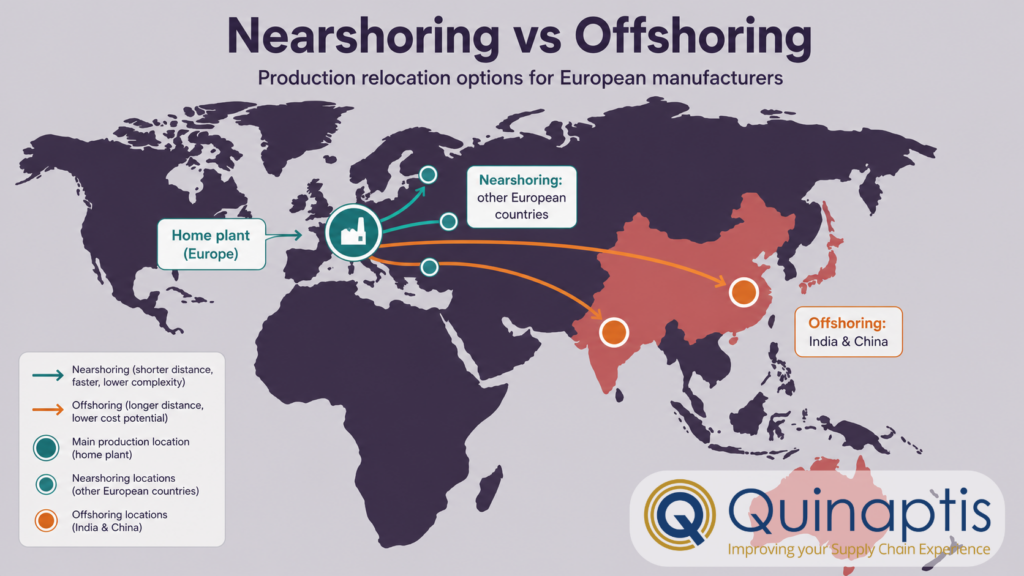
Nearshoring reduces certain risks — but only when supported by the right technology and data.
Automation goes far beyond robots
Warehouse automation accelerated sharply after labor shortages exposed how fragile people-dependent operations can be. Robotics help stabilize execution, but physical automation is only one part of the picture.
The real transformation happens in the intelligence layer of your supply chain:
- Demand forecasting
- Supplier selection
- Transport planning and routing
- Documentation and compliance
- Customer communication
Repetitive, high-volume tasks scale poorly with people. Software scales better, faster, and more consistently — freeing your teams to focus on exceptions, improvement, and customer value.
The biggest operational risk today is often not technology failure, but humans becoming the bottleneck.
Agentic AI: when systems start acting
The next evolution of automation is agentic AI. These are intelligent software agents that don’t just analyze or alert — they take action.
Unlike traditional rule-based systems, agentic AI:
- Processes real-time signals
- Adapts to changing conditions
- Makes context-aware decisions
- Learns from outcomes
In logistics and procurement, this enables automation of tasks that were previously considered too complex or variable. Human planners are not replaced — they are elevated from firefighting to orchestrating the network as a whole.
Data quality is still the hard part
Advanced automation only works when the underlying data is reliable. Many organizations still struggle with:
- Fragmented systems
- Incomplete master data
- Inconsistent process execution
Traditional ERP systems are excellent at executing transactions, but they were never designed to deliver end‑to‑end insight across the entire supply chain.
This is where modern analytical techniques add value. Process mining, for example, shows how processes actually run in reality — revealing deviations, inefficiencies, compliance risks, and supplier issues that would otherwise remain hidden.
The shift is from:
- Looking back at what went wrong
to
- Predicting what might go wrong
and increasingly
- Recommending what to do next
Digital twins: test decisions before you commit
Digital twins are becoming a practical tool for large, logistics‑intensive organizations. A digital twin is a continuously updated virtual model of your supply chain, fed by real-time operational and external data.
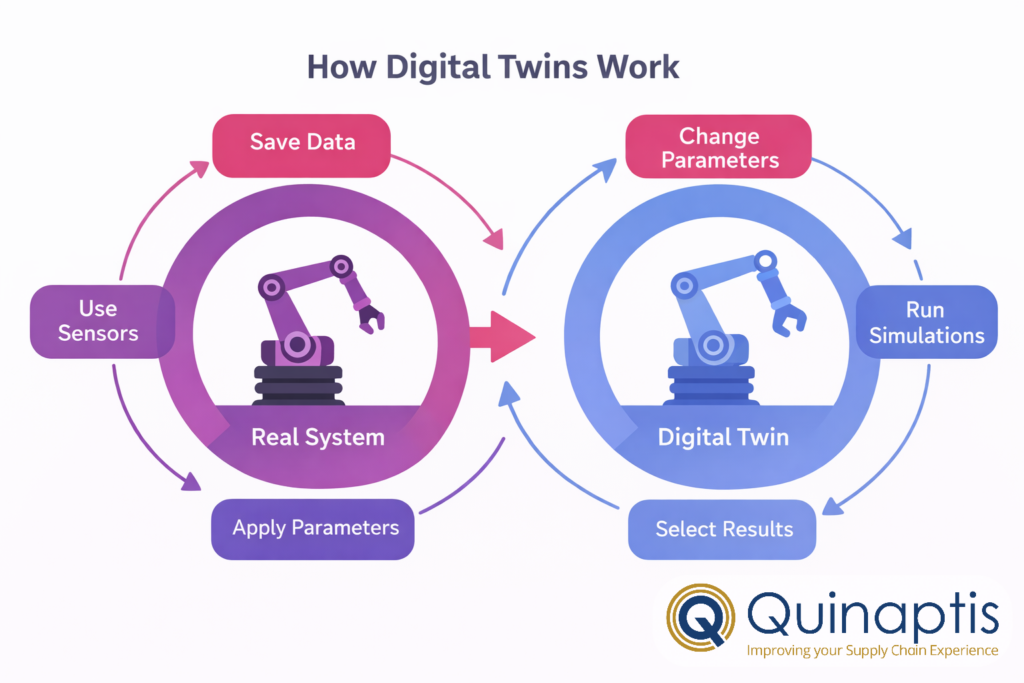
With a digital twin, you can:
- Simulate disruptions such as port closures or supplier failures
- Compare cost, service, resilience, and CO₂ impact side by side
- Stress-test scenarios in hours instead of weeks
- Make investment decisions with far more confidence
Instead of debating assumptions, you evaluate evidence-based scenarios before acting.
Sustainability is now an operational variable
Sustainability has moved from reporting to decision-making. European regulations increasingly affect:
- Supplier selection
- Transport modes
- Network design
- Sourcing strategies
Scope 3 emissions — generated across your supply chain — are now a strategic concern. Modern supply chain platforms allow you to optimize cost, lead time, resilience, and carbon footprint together, rather than sequentially.
Automation makes sustainability measurable, manageable, and actionable.
Risk never disappears — but your response improves
No technology removes risk entirely. Every mitigation strategy involves trade-offs, whether that is inventory buffers, alternative sourcing, or capacity redundancy.
What has changed is your ability to see, decide, and act faster.
With continuous monitoring, intelligent automation, AI-driven planning, and digital twins, you gain:
- Earlier visibility into problems
- Better understanding of trade-offs
- Faster, safer decision-making
The companies that perform best are not those that avoid risk, but those that adapt quickly when the unexpected happens.
Want to reduce risk in your supply chain without sacrificing performance?
Talk to Quinaptis to explore how automation, AI, and data-driven supply chain design can support your next steps.