Why PLC integration matters now
In modern warehouses, data flows from many systems—from inventory platforms to physical automation equipment. But these two worlds don’t always speak the same language. Without strong PLC integration, warehouses miss opportunities to automate tasks, optimise crane movements or even let equipment prepare work autonomously overnight.
To overcome this gap, Siemens, Quinaptis, and Thomas More Hogeschool joined forces to build a safe, accurate and scalable link between SAP EWM and programmable logic controllers (PLCs). Their collaboration shows how combining expertise leads to smarter warehouse automation.
Connecting SAP EWM and PLCs: two worlds, one challenge
Logistics teams rely on SAP EWM to manage inventory and goods flows. Automation engineers use PLCs to operate cranes and warehouse equipment. These domains traditionally work separately, making integration complex but highly valuable.
Quinaptis had already been exploring ways to optimise automated warehouses through SAP’s Material Flow System (MFS). But deep automation expertise was required to build a reliable bridge to PLCs.
That’s where Siemens, the market leader in PLC technology, stepped in.
Together, Quinaptis consultant Dieter Baert and Siemens automation expert An Lietaert explored various integration paths. The turning point came with the idea of using Virtual Commissioning—testing a system virtually using a digital twin before real-world deployment.
Using Siemens NX MCD combined with PLC‑SIM Advanced (Simatic S7‑1500), the team set out to create both a real and a virtual warehouse setup.
Building the project team: expertise meets fresh talent
To accelerate development, the two companies partnered with Thomas More Hogeschool, known for its strong PLC programmes.
Professor Frank Peeters assigned two motivated electromechanics students—Gillian Stevens and Stef Dierickx—despite them having no prior experience with NX MCD or SAP.
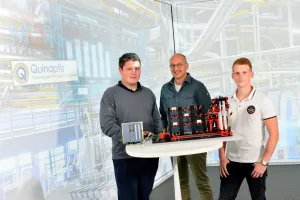
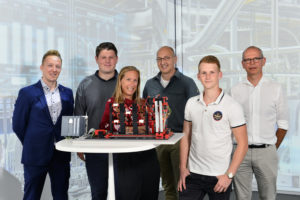
The project team brought together:
- 2 experts from Quinaptis
- 2 experts from Siemens
- 2 bachelor students from Thomas More
The students received intensive training: first on Siemens NX MCD, then on SAP EWM with guidance from Quinaptis. This multidisciplinary setup proved to be one of the project’s biggest strengths.
Creating both a physical and digital proof of concept
To validate the concept thoroughly, the team worked with both HiL (Hardware‑in‑the‑Loop) and SiL (Software‑in‑the‑Loop) approaches.
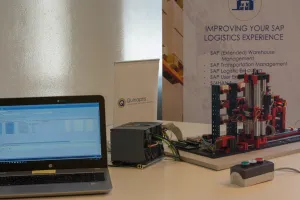
Physical model: a miniature warehouse
A Fischer Technik automated warehouse, controlled by a Siemens PLC, served as the hands‑on environment. This enabled the team to:
- refine communication between SAP EWM and the PLC,
- test commands and responses,
- validate real‑world behaviour.
Digital model: the warehouse’s digital twin
In parallel, the students built a full NX MCD digital twin, allowing them to:
- simulate crane movements,
- uncover issues earlier,
- test faults safely and proactively,
- debug faster without needing physical hardware.
The combined approach delivered a fully functioning proof of concept. The NX MCD tool not only verified communication between SAP EWM and the PLC, but also showed the concept was scalable to real‑size warehouses with industrial cranes.
And the potential doesn’t stop there. The same model could be used to integrate other automated devices such as AGVs or robots.
A successful co innovation with lasting value
All three partners describe the collaboration as highly enriching.
The students gained hands-on experience with SAP EWM, NX MCD and virtual commissioning—and it showed: they earned 17/20 for their bachelor project.
Thomas More sees this as a model for future cooperation between industry and education.
For Siemens and Quinaptis, the benefits go beyond the proof of concept:
- Quinaptis gained practical experience with Virtual Commissioning.
- Both companies strengthened their shared understanding of how SAP MFS interacts with PLCs.
- Future integration projects will be faster thanks to improved cross‑team communication.
As An Lietaert from Siemens puts it: When experts from different domains collaborate, the whole becomes greater than the sum of the parts.
Want to explore how PLC integration and Virtual Commissioning can improve your warehouse automation?
Contact us to discuss your use case or request a demo.