Every summer, somewhere between June and August, when speaking with customers, we hear the same kind of stories. A warehouse manager in Wallonia mentions that pickers are slowing down after lunch. A distribution centre near Antwerp has had two forklifts go into thermal shutdown in one week. Someone in a food distribution hub asks whether their ambient zone still qualifies as “ambient” when the mercury outside hits 35°C. These are not hypothetical worries. Belgium logged an orange heat alert in June 2026, with temperatures exceeding 35°C across much of the country, and the Royal Meteorological Institute has flagged repeated heatwave conditions through July. For a region whose warehouses were largely designed around a temperate climate, this is a structural problem, not a one-off nuisance.
At Quinaptis we spend most of our time inside SAP EWM implementations, talking about slotting strategies, wave planning and automation interfaces. Heat rarely appears on a project charter. Yet it touches almost every layer of a distribution operation: the people who do the picking, the building that houses them, the machines that move the goods, and the storage logic that decides where a pallet belongs. This article walks through those four layers, with the numbers behind them, and looks at where warehouse software and automation genuinely help.
The Human Cost of a Hot Warehouse
Heat does not just make people uncomfortable. It measurably increases the odds of getting hurt. A large 2025 study analysing over 845,000 OSHA-reported occupational injuries in the United States found that injury risk starts climbing once the heat index passes roughly 85°F (29°C) and accelerates sharply above 90°F (32°C). Transportation and warehousing accounted for close to 22% of all injuries in that dataset, the second largest share after construction. Nationally, the researchers estimate around 28,000 workplace injuries a year are directly attributable to heat exposure, and they consider this a conservative figure because most heat-related incidents are never coded as such.
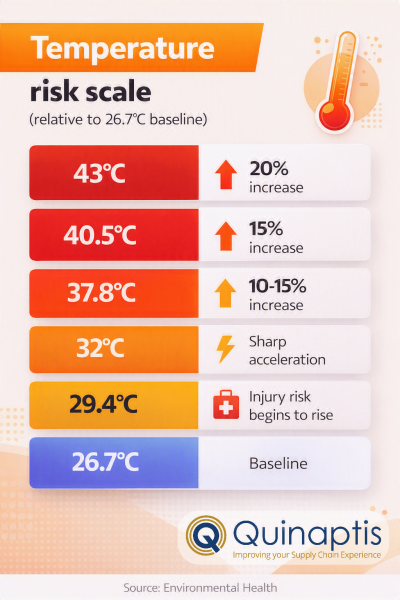
What is striking is that this pattern shows up almost everywhere, including indoor, seemingly climate-shielded jobs. The study’s authors describe a fairly universal physiological response: once workers become thermally uncomfortable, motor skills, balance and concentration degrade, and that translates into slips, drops, and handling errors rather than heatstroke alone. OSHA’s own occupational heat guidance explicitly lists warehousing among the industries where workers have suffered heat-related illness, alongside bakeries, foundries and boiler rooms – a reminder that “indoor” is not the same as “climate controlled”.
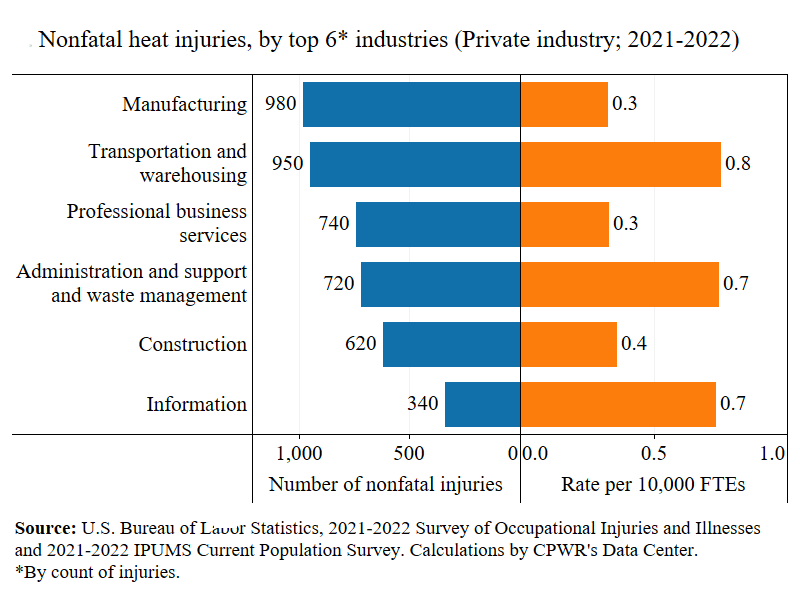
The trend is also getting worse over time, not better. Heat-related fatal injuries among all US workers rose 77% between 2012 and 2023, according to analysis by CPWR (The Center for Construction Research and Training), and separate injury statistics show thousands of lost-workday cases every year tied to environmental heat. The International Labour Organization frames this as a productivity issue as much as a safety one: heat stress reduces the pace and precision of manual work well before anyone reaches the point of collapse.
Fortunately, we humans tend to protect ourselves: ask any operator in the warehouse and they will be able to tell where the hottest spots are. Consequently they’ll try to avoid these in the afternoon, but of course, that is not always possible.
The remedies are not exotic. OSHA’s recommendations, echoed by most occupational health bodies, come down to acclimatisation time for new or returning staff, shorter shifts or more frequent breaks during peak heat, hydration, and access to shade or cooled rest areas. What is less obvious, and where our field intersects with this, is that a well-configured warehouse management system can operationalise these measures instead of leaving them to a supervisor’s memory. Break scheduling, task interleaving to reduce time in the hottest zones, and dynamic rebalancing of workload between shifts are all things that SAP EWM can support through labour management and resource scheduling functionality, provided someone has actually built the rules for it.
Buildings Built for a Different Climate
Most large distribution buildings in the Benelux were designed following construction norms suited to a cool, damp, moderate climate: modest roof insulation, natural ventilation through roof vents, and cooling treated as a secondary concern compared to heating. Southern European and North American warehouse design guides, by contrast, put far more emphasis on solar load, reflective roofing and mechanical cooling from the outset. That difference is now becoming a liability as Belgian summers increasingly deliver multi-day stretches above 30°C, something that historically happened rarely but occurred in three of the last four years according to RMI heatwave records.
If we had to pick one building feature that operators consistently underestimate, it would probably be the loading dock. Every open dock door is effectively a hole in the building’s thermal envelope. Engineering studies on warehouse infiltration show that heat and cooled or heated air pour through open dock doors at rates of several hundred cubic feet per minute per door, and that a poorly sealed dock leveler can let internal temperature swing by close to 30 degrees right at the dock plate, compared to only a few degrees for a properly enclosed dock house design. For a facility running dozens of dock doors on a busy cross-dock schedule, that adds up to a continuous, largely invisible drain on both comfort and energy budget. Simple measures – dock seals, shelters, strip curtains, and scheduling systems that only unlock a door when a trailer is actually present – are shown to cut this infiltration meaningfully and often deliver payback within one to two years, depending on energy costs and dock utilisation.
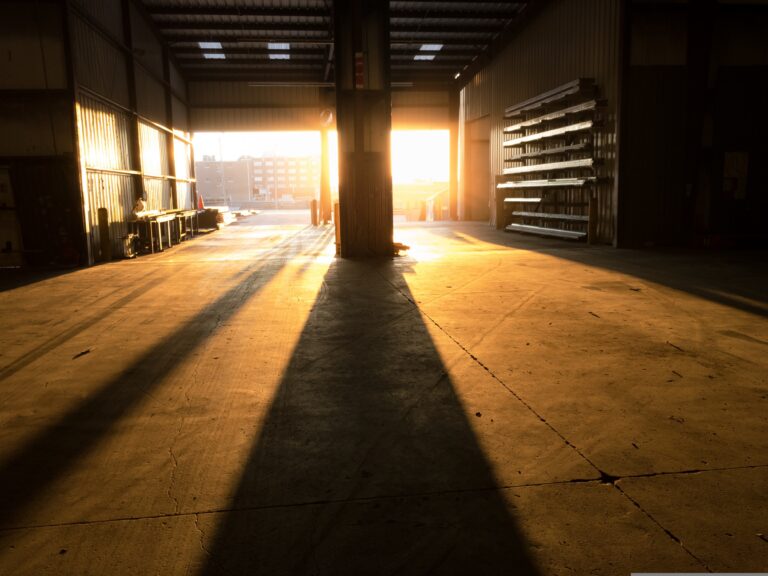
Of course, part of a solution is also the discipline of the operators to only have the dock doors open when needed and to close them when not in use. Many warehouses invest in cooling before fixing the operational behaviours that create the problem.
This is where dock scheduling intersects with warehouse software again. SAP EWM’s yard and dock appointment functionality can enforce exactly this kind of discipline: doors open only for a scheduled, confirmed arrival, rather than sitting ajar for convenience. It will not fix an under-insulated roof, but it removes one of the more wasteful and controllable sources of heat gain.
Machines Do Not Like Heat Either
Warehouse automation, from conveyor motors to conventional forklifts and increasingly to lithium-powered AGVs (Automated Guided Vehicle), has its own heat tolerance, and it is lower than people generally assume. Lithium-ion forklift batteries are commonly rated for stable operation in the 15 to 35°C range, and data from battery manufacturers indicates capacity loss of roughly 20% per 500 cycles at operating temperatures above 45°C, compared to about 8% at 30°C. Above certain thresholds the battery management system will actively throttle output to protect the cells, cutting available power by as much as half, and repeated thermal stress raises the risk of swelling, faster self-discharge, and in rare but documented cases thermal runaway.
The practical consequence for a busy site is downtime exactly when throughput is most needed. Analysts tracking fleet data note that unmanaged battery heat can force midday swaps and cut effective productivity by around a quarter in multi-shift operations, while proactive thermal monitoring has been shown to cut unscheduled downtime by up to 60%. Conveyor motors, sortation systems and automated storage and retrieval equipment face a milder version of the same problem: motors and electronics are typically rated to an upper ambient limit, and running consistently near that ceiling shortens component life and increases the odds of an unplanned stop.
None of this is solved by SAP software directly, but it is very much a planning and visibility problem. A warehouse execution layer that tracks equipment utilisation, integrates maintenance schedules and can flag heat-driven charging or cooling breaks into task sequencing helps translate a facilities issue into an operational one that gets managed proactively rather than discovered as a breakdown on the floor.
Does “Ambient” Still Mean What It Used to Mean?
This is the question that touches storage strategy most directly, and it matters far beyond pharma. In regulated logistics, “ambient” is not a vague term for “room temperature, whatever that is.” GDP (Good Distribution Practice) guidelines define controlled ambient storage as a band, typically 15 to 25°C, sometimes stretched to 30°C, maintained within a well-ventilated space and validated through formal temperature mapping before the space is even put into use. Products labelled “store below 25°C” or “store below 30°C” are making a legal claim about the environment they will sit in, not a general assumption.
When outside temperatures regularly exceed 30°C for days at a stretch, a warehouse zone that was mapped and validated as “ambient” under yesterday’s climate assumptions can quietly drift out of its qualified range, particularly near roofs, skylights, or dock areas exposed to solar gain. GDP guidance already requires re-mapping after facility changes, adverse trend signals, or seasonal risk shifts, precisely because ambient is a measured and monitored condition, not a fixed fact. For companies outside strict pharma regulation, the same logic still applies informally: food ingredients, chemicals, electronics and certain packaging materials all have their own tolerance windows, and what used to be a safe default assumption about Benelux ambient conditions is becoming less safe to assume.
During one hospital project, staff noticed that some ointments were degrading faster during summer months. The products were perfectly protected in central storage, but not always in ward-level stockrooms where temperature control was far less rigorous.
This has a direct consequence for warehouse slotting logic. A storage strategy that assigns locations purely on turnover velocity or pallet dimensions, without a temperature or zone attribute, is no longer sufficient for heat-sensitive stock in a warming climate. SAP EWM allows storage type and bin-level attributes to encode temperature zones, and putaway strategies can be configured to steer sensitive SKUs away from dock-adjacent or roof-exposed bins during high-risk periods, with monitoring data feeding back into location suitability decisions. Getting this configured properly, and keeping it aligned with actual mapping data rather than an assumption made at go-live years ago, is exactly the kind of unglamorous but consequential consulting work that pays for itself the first time it prevents a batch of temperature-sensitive stock from being written off.
Where This Leaves a Warehouse Operator
Heat management in a warehouse is not one problem but four connected ones: protecting the people, tightening the building envelope, keeping automation within its operating window, and making sure storage logic reflects the actual thermal reality rather than a historical assumption. None of these are solved by buying a single piece of kit. They are solved by combining sensible facility investment, like dock seals and better scheduling discipline, with a warehouse management system that is configured to actually use the data available to it: labour scheduling that respects heat exposure, dock appointment control that limits infiltration, equipment monitoring that anticipates thermal throttling, and slotting rules that treat ambient as a variable to be tracked rather than a constant to be assumed.
Many Benelux warehouses were not built for the summers they are now getting. Adjusting the building takes years and capital. Adjusting the software that runs the operation inside that building can happen much faster, and it is often the difference between reacting to a heatwave and having already planned for one.
Sources
- Is Belgium heading for a new official heatwave?
- Belgium under health alert as record-high heatwave hits the continent
- A nationwide analysis of heat and workplace injuries in the United States
- New Study: As Heat Rises, So Do Workplace Injuries
- Nearly 28,000 Work Injuries Every Year are Linked to Hot Weather
- Overview: Working in Outdoor and Indoor Heat Environments
- Work Safety: Exposure to Environmental Heat – Injury Facts
- Heat Injuries and Illnesses among Construction Workers, Data Bulletin AUGUST 2025
- Working on a warmer planet: The impact of heat stress on labour productivity and decent work
- Will there be another heatwave in Belgium next week?
- Energy Design Guide For Warehouses – Loading Dock Infiltration
- The Importance of Energy-Efficient Loading Dock Equipment
- The Cold, Hard Truth About Energy Loss at the Loading Dock
- Minimizing the Loss of Energy at the Loading Dock
- Warehouse Forklift Battery Overheating Triggers Federal OSHA Case
- Why Is Thermal Management Crucial In High-Performance Forklift Batteries? – Redway Power™
- Guide to Good DIstribution Practice for Pharmaceutical Products
- Temperature Compliance for Pharmaceutical Warehouses
- Understanding Good Distribution Practice in ThePharmaceutical Industry