The real issue: disruption is now permanent
The expected ceasefire between the United States and Iran may bring short-term relief. Energy prices are easing, and the reopening of the Strait of Hormuz appears within reach.
But for CEOs, CFOs, and COOs, this is not the moment to relax.
Supply chain disruption is no longer a temporary crisis. It is the operating environment. Peace may reduce immediate pressure but it will not undo the structural risks that now define global trade.
A shock that exposed systemic fragility
The February 2026 escalation in the Middle East showed just how quickly global supply chains can destabilize:
- Vessel traffic through the Strait of Hormuz dropped by 95%
- Around 20% of global oil and gas flows were disrupted
- Freight rates rose 25–35%
- War-risk insurance premiums increased tenfold
- Rerouting added 10–14 days and up to 35% more fuel consumption
Critical industries beyond energy were also affected:
- Semiconductors and healthcare faced helium shortages
- Agriculture saw urea (fertilizer) prices rise 19% in one week
- Metals and chemicals exports stalled
- Air freight through Gulf hubs (≈4% of global volume) was disrupted
The lesson is clear: even localized geopolitical events now create global operational shocks within days.
Peace is coming but recovery will take much longer
Even if the Strait of Hormuz reopens fully, normalization will not be immediate.
Industry leaders and analysts highlight several realities:
- Energy and LNG infrastructure repairs may take years
- Shipping backlogs could take 275+ days to clear
- Insurers and carriers will require extended stabilization periods
- Contract disputes and missed deliveries will ripple into 2027
For finance leaders, the impact is already visible:
- Unhedged companies are absorbing multi-quarter losses
- Cost volatility in transport, energy, and materials remains high
- Working capital pressure is increasing due to inventory adjustments
In short: the crisis may end, but its financial and operational consequences will persist.

The bigger pattern executives can no longer ignore
The Hormuz disruption is not an isolated event: it is part of a clear pattern:
- 2018–2025: US-China trade tensions and tariffs
- 2020: COVID-19 supply chain collapse
- 2021: Evergreen Suez Canal blockage
- 2022-2026: War in Ukraine
- 2023–2024: Red Sea shipping disruptions
- 2026: Iran conflict
Data confirms this structural shift:
- 93% of EU firms reported disruptions between 2020–2023
- Supply chain incidents rose 38% year-over-year in 2025
- Geopolitical, cyber, and regulatory risks are all accelerating
Disruption is no longer exceptional, it is a given. But most planning models still assume the opposite.
For the C-suite, this changes the strategic question from:
“How do we recover?”
to:
“How do we operate effectively in constant disruption?”
Moving from “just-in-time” to “just-in-case” and beyond
Traditional just-in-time supply chains optimized for cost and efficiency. They depend on:
- Stable transport
- Predictable demand
- Reliable sourcing
Those assumptions no longer hold.
Leaders are shifting toward resilience-focused models, including:
- Nearshoring and regionalization
- Dual sourcing strategies
- Targeted inventory buffers
The goal is to balance cost with continuity and agility.
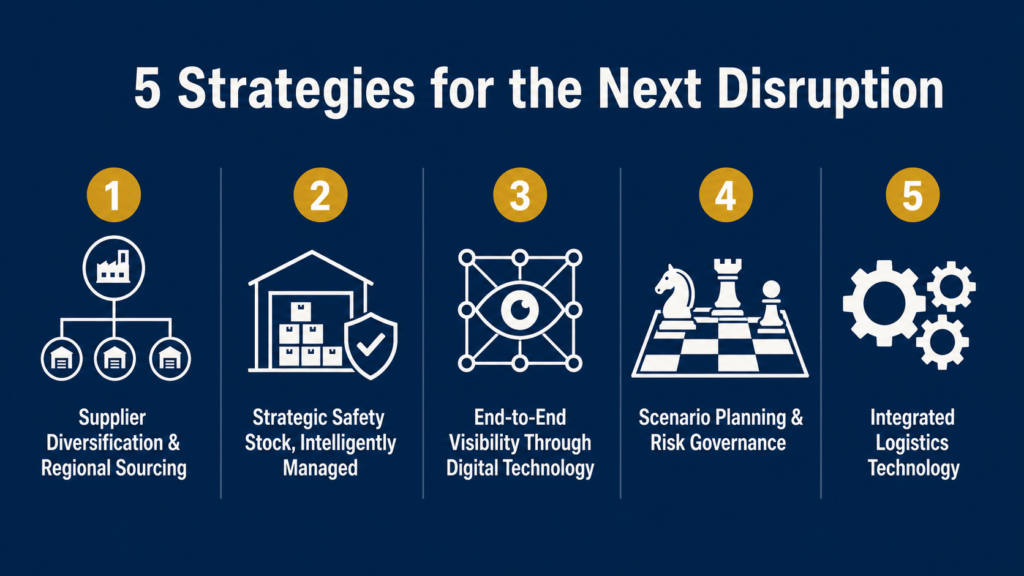
Five strategies to strengthen supply chain resilience
1. Supplier diversification and regional sourcing
Single-source dependency is now a critical risk.
Organizations that diversify suppliers:
- Recover faster from disruptions
- Reduce regional exposure
- Gain negotiating flexibility
For companies in the Benelux, near-shoring to Eastern Europe, Turkey, or North Africa provides practical alternatives to Asia-heavy sourcing.
Executive priority: build optionality, even if it requires upfront investment.
2. Strategic safety stock, managed intelligently
The shift to “just-in-case” inventory must be precise.
Key principle:
- Not all SKUs need extra stock
- Critical items should be buffered, others optimized
Modern AI tools enable:
- Dynamic safety stock levels
- Scenario-based inventory planning
- Better working capital allocation
For CFOs, this reframes inventory:
Not as a cost center but as a controllable insurance mechanism.
3. End-to-end visibility through digital technology
You cannot respond to disruptions you cannot see.
Advanced tools such as digital twins provide:
- Real-time supply chain visibility
- Scenario simulations (e.g., route closures, cost spikes)
- Faster, data-driven decision-making
Modern AI capabilities can:
- Validate suppliers automatically
- Trigger replenishment actions
- Reduce lead times by up to 25%
For COOs, visibility is now a non-negotiable capability.
4. Scenario planning and risk governance
Leading organizations no longer treat risk planning as an annual exercise.
Instead, they:
- Maintain live scenario models
- Prepare for shocks such as:
- 10–30% energy price increases
- 20–40% freight cost spikes
- Major route disruptions
- Define clear response playbooks and escalation paths
When disruption hits, the goal is not improvisation but execution.
5. Integrated logistics technology
Speed of response depends on system integration.
Fragmented tools slow decision-making. Integrated platforms enable:
- Real-time inventory visibility
- Multi-modal transport flexibility
- Automated compliance and trade processing
- Scenario-based orchestration across operations
Solutions like SAP EWM, SAP TM, and SAP GTS within SAP S/4HANA illustrate how:
- Data flows seamlessly
- Compliance is automated
- Decisions are coordinated across the supply chain
The latest generation of orchestration tools can:
- Detect disruptions early
- Assess impact instantly
- Trigger automated responses across planning, logistics, and procurement
Integration is an enabler of resilience instead of an IT upgrade.
From resilience to antifragility
Resilience helps you survive disruptions.
Antifragility helps you improve because of them.
An antifragile supply chain:
- Learns from every disruption
- Adapts continuously
- Gains competitive advantage under stress
Forward-looking organizations are investing in:
- Distributed supply networks
- Advanced orchestration capabilities
- Strategic flexibility and optionality
For companies in logistics hubs like Antwerp and Rotterdam, this is a unique strategic opportunity to strengthen market position while others struggle to adapt.
Where Quinaptis fits in
At Quinaptis, we help organizations turn supply chain resilience into an operational reality.
With deep expertise in SAP EWM, SAP TM, and related modules, we enable:
- Real-time inventory visibility to detect risks early
- Flexible transport planning to reroute when disruptions occur
- Integrated execution across logistics, procurement, and compliance
Our focus is practical: delivering solutions that perform in complex, high-risk logistics environments.
The question every executive should ask
“Are we building a supply chain that gets better every time disruption happens?”
The Iran peace deal is good news.
The next disruption is still coming. And the time to prepare is now.
Want to future-proof your supply chain?
Contact Quinaptis to explore how integrated SAP solutions and resilience strategies can help your organization respond faster, reduce risk, and stay competitive in an unpredictable world.