Every year, warehouse managers face a familiar reality. Order volumes continue to move, customers still expect service levels to be maintained, yet many of the people who know the operation best are on holiday.
The summer period exposes something that is often hidden during the rest of the year. Warehouses do not run on software alone. They run on people using software.
When experienced operators, team leaders and inventory specialists are temporarily absent, their knowledge leaves the building with them. New employees, temporary workers and less experienced staff must fill the gaps. Suddenly, questions emerge that rarely appear in software selection projects:
- How quickly can someone learn the system?
- How many mistakes occur during the first week?
- How dependent is the operation on tribal knowledge?
- How much supervision is required?
- How easily can a worker recover from an exception?
These questions may be less exciting than discussions about AI-driven slotting, digital twins or autonomous robots, but they often have a greater impact on operational performance.
Unlike peak seasons, summer disruptions rarely arrive all at once. The challenge develops gradually as different employees take leave at different times, creating a constantly changing mix of experience levels on the warehouse floor.
The evolution of warehouse management systems
Warehouse management systems have come a long way from the paper-based processes that dominated warehouses for decades.
Early warehouses relied on manual inventory records, printed pick lists and the experience of operators who knew where everything was located. As operations grew more complex, organizations adopted computerized inventory-control systems, barcode technologies and eventually dedicated WMS platforms that provided real-time inventory visibility and workflow management. Today, advanced WMS solutions increasingly integrate automation, robotics, artificial intelligence and predictive analytics.
The benefits are undeniable. Modern WMS solutions can improve inventory accuracy, optimize storage locations, reduce travel distances and provide better control over warehouse activities. They have become essential infrastructure for many distribution operations.
Yet the drive toward greater sophistication sometimes creates a paradox.
The more functionality a system contains, the more difficult it can become for people to use effectively.
A warehouse may have invested millions in advanced technology, but if a temporary worker cannot confidently complete a put-away task after basic training, that sophistication may provide less value than expected.
Summer exposes operational weak points
Peak seasons often receive most of the attention in logistics discussions. Black Friday, Christmas and end-of-quarter surges generate extensive planning efforts.
Summer brings a different challenge.
Demand may remain relatively stable while workforce experience declines.
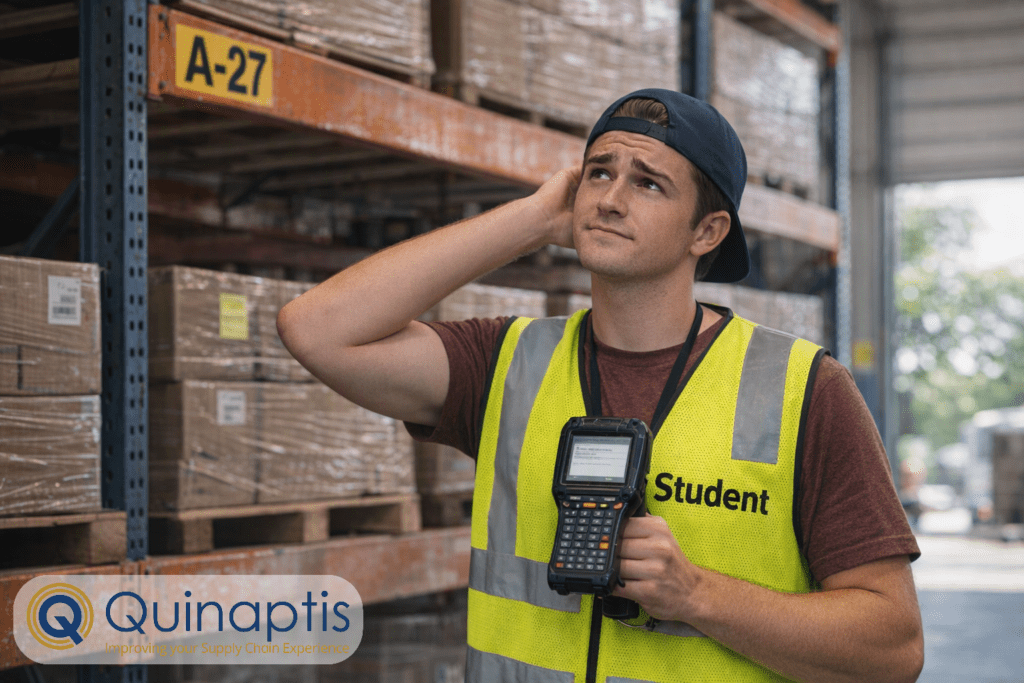
Temporary workers often enter the operation with limited knowledge of warehouse processes. A student worker starts on Monday, receives a 45-minute briefing and by Tuesday morning is standing in front of rack A-27 wondering whether the stock needs to be moved, counted or replenished. At the same time, supervisors who would normally provide support may themselves be covering multiple roles due to holiday absences. Also experienced employees will be performing unfamiliar tasks while covering for colleagues on leave.
The result is increased risk in several areas:
- Picking errors
- Inventory inaccuracies
- Longer task completion times
- Safety incidents
- Overtime requirements
- Reduced throughput
Research and industry experience consistently show that onboarding temporary warehouse workers is one of the most significant operational challenges during seasonal labour fluctuations. Organizations frequently cite training time and workforce readiness as major determinants of productivity during these periods.
What often determines success is not necessarily the sophistication of the warehouse software. It is how effectively the software supports people who are still learning.
The hidden cost of complexity
Many warehouse software selection projects focus primarily on functionality.
The evaluation checklist grows rapidly:
- Advanced replenishment logic
- Slotting optimization
- Labor management
- Yard management
- Automation integration
- AI forecasting
- Analytics platforms
- Custom workflow engines
All of these capabilities may be valuable.
However, usability rarely receives the same attention. In many software selections, usability is treated as a secondary concern until go-live. By then, changing it becomes expensive. That’s a mistake.
This is understandable because usability is difficult to quantify during procurement. Demonstrating an advanced optimization algorithm is easier than measuring how quickly a temporary picker can become productive. Especially during holiday periods, ease of learning is becoming a strategic criterion rather than simply a user-interface concern.
Labor remains one of the largest cost components in warehouse operations. If employees struggle with system navigation, transaction execution or exception handling, the impact accumulates across thousands of daily activities. Industry experts increasingly recognize that user experience significantly affects onboarding speed, productivity and labour efficiency.
A warehouse system should help people make correct decisions with minimal effort, not just manage inventory.
The role of guided work
One important trend in modern warehouse operations is the move from transactional software toward guided execution.
Traditional systems often assumed workers already knew the correct process. The system merely recorded completion.
Newer technologies actively guide operators through tasks.
The objective is simple: reduce the dependence on individual experience.
Rather than expecting a worker to remember warehouse locations, optimal routes or exception procedures, the technology provides instructions at the moment they are needed.
This approach becomes particularly valuable during periods with many new or temporary workers.
Several technologies have emerged to support this model.
Voice picking: reducing friction
Voice picking is one of the clearest examples of technology designed around human usability.
Instead of reading paper lists or constantly checking handheld devices, workers receive spoken instructions through a headset.
The operator keeps both hands free and focuses attention on the task rather than the screen.
Voice-directed workflows have been implemented across a wide range of industries, including retail, pharmaceuticals, food distribution and consumer goods logistics.
Results reported by various organizations are notable.
Honeywell documented warehouse operations achieving accuracy levels above 99.5% after implementing voice solutions. Other implementations reported productivity improvements of approximately 15% while also reducing picking errors.
The reason voice technology often works well is surprisingly simple. It reduces cognitive load: Workers do not need to alternate between reading instructions, looking at locations and performing physical tasks. The process becomes more natural, which is especially valuable for employees who have not yet built experience.
We can confirm this from our own experience: In 2025, we implemented voice picking in the warehouses of two of our customers in Belgium (one horticulture wholesaler and a chemicals company). They saw faster operations, double-digit productivity gains and near perfect accuracy.
RF workflows still matter
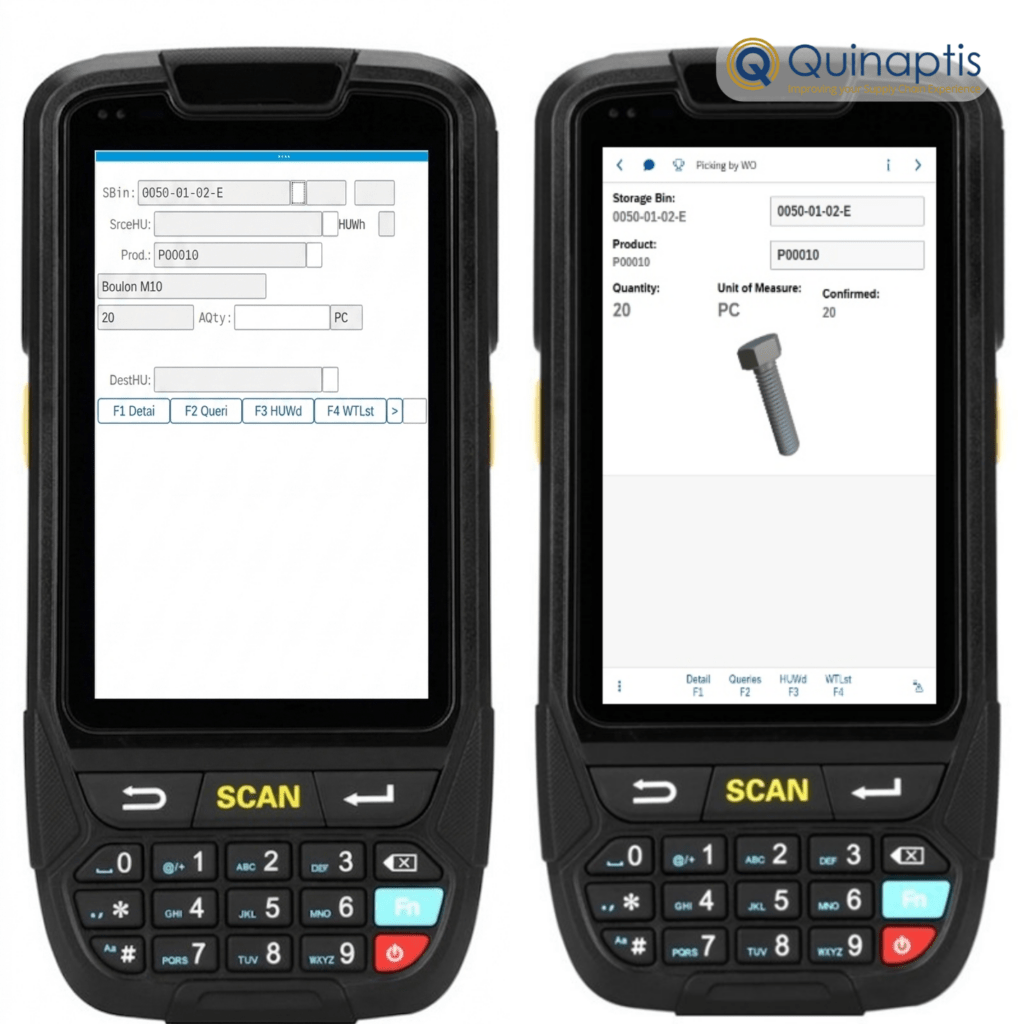
Voice technology receives considerable attention, but simple RF workflows remain one of the most powerful tools available to warehouse operators.
A well-designed RF process can dramatically lower training requirements. The most effective workflows reduce uncertainty. When a worker always knows the next action to take, errors decrease and productivity increases.
The difference often lies in details:
- Clear screen layouts
- Limited data entry
- Sequential guidance
- Immediate validation
- Meaningful error messages
Many warehouse workers interact with RF devices hundreds or thousands of times per day. Small improvements in usability therefore generate substantial benefits. In SAP EWM projects, clients often spend months validating automation interfaces and advanced warehouse processes. Yet few organisations test whether a newly hired operator can complete a standard pick flow after only one hour of training. For more information on this topic, also check out these blogs: https://quinaptis.com/blog/?e-filter-1ee4009-category=prebilt-en.
Augmented reality and visual guidance
Augmented reality has attracted significant interest in warehousing over the past decade.
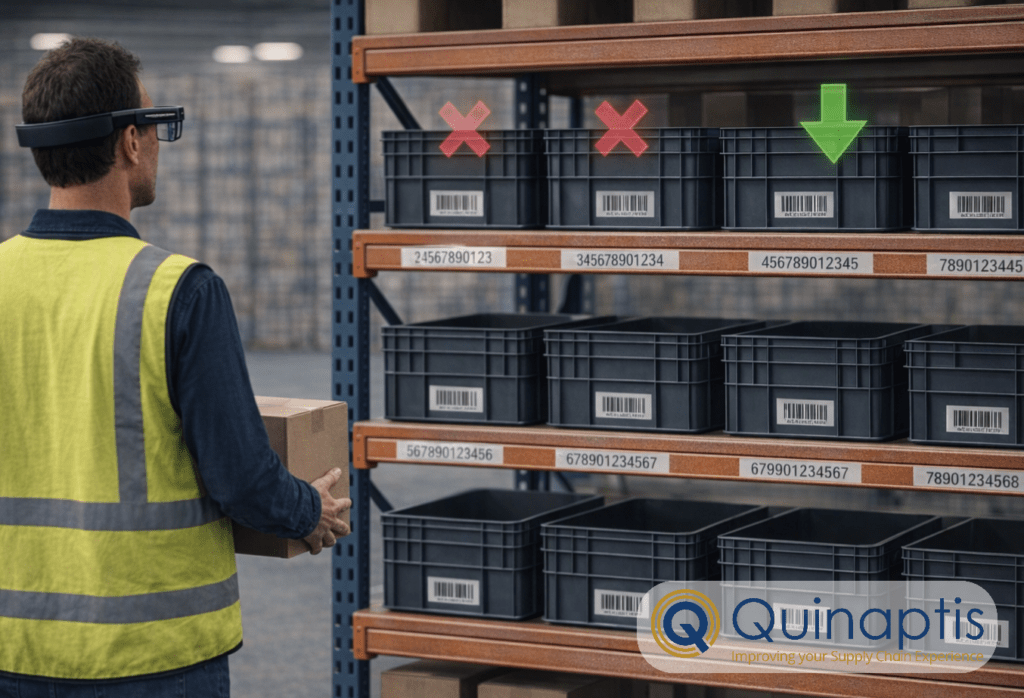
Using smart glasses or heads-up displays, workers can receive visual instructions directly within their field of view.
Location guidance, product information and picking instructions appear without requiring workers to consult separate devices.
Although adoption remains less widespread than voice technology, results from pilots and operational deployments are encouraging.
DHL reported productivity improvements of around 25% in an early vision-picking pilot and around 15% in broader operational deployments. Research studies have also documented reductions in picking errors and accuracy levels approaching 99% in certain warehouse environments.
Technology providers additionally emphasize reduced training requirements because new workers can follow visual instructions rather than relying on memory or prior experience.
Despite encouraging results, ROI and large-scale adoption remain under evaluation in many organizations. While AR is not yet the default choice for most warehouses, it highlights an important principle:
Good technology shortens the distance between instruction and execution.
Technology alone is not enough
There is an important caveat.
Technology does not solve broken processes.
- Voice picking cannot compensate for unclear inventory ownership.
- Smart glasses cannot fix inconsistent location structures.
- Advanced WMS workflows cannot eliminate confusion if operating procedures vary between shifts.
The most successful technology implementations usually share a common characteristic: process standardization.
When processes are consistent, technology reinforces good behaviour.
When processes are inconsistent, technology often makes problems more visible rather than resolving them.
This is why some warehouses achieve exceptional results with relatively modest technology stacks, while others struggle despite major software investments.
The foundation remains operational discipline.
What warehouse leaders should really evaluate
When evaluating warehouse technology, especially in labour-intensive environments, a useful question is often overlooked:
“How well would this system perform during the second week of August, when half my experienced operators are on holiday and temporary workers are running core processes?”
That scenario may sound extreme, yet summer holidays create versions of it every year.
A useful evaluation framework includes questions such as:
- How quickly can a new employee become productive?
- How many training hours are required?
- How dependent are workflows on personal knowledge?
- How easy is exception handling?
- How many mistakes occur during onboarding?
- Can workers follow the process confidently without constant supervision?
These factors may not appear in glossy product demonstrations, but they frequently determine real-world success.
The real measure of warehouse technology
The future of warehouse management will undoubtedly include more automation, more AI and more advanced optimization.
Those developments will continue to create value.
At the same time, warehouses will remain environments where people play crucial roles for many years to come.
For that reason, the discussion around WMS selection should extend beyond feature lists and technical sophistication.
A great warehouse management system is not merely the one that can do the most.
It is the one that helps people do the right thing, consistently, safely and efficiently.
Summer holidays remind us of that every year.
When experienced employees are away and temporary workers take their place, warehouses discover whether their operations truly depend on technology or on people compensating for technology.
A warehouse that only works when its experts are present is not truly optimized. Summer has a way of revealing that. The real warehouse acceptance test happens in the second week of August.
Sources
- Körber Supply Chain – Seasonal workforce productivity and warehouse technology. [koerber-su…ychain.com]
- Logiwa – Warehouse Management System adoption and capabilities. [logiwa.com]
- Intuendi – Evolution and capabilities of modern WMS platforms. [intuendi.com]
- Honeywell Voice case studies (Al Nahdi, Würth Austria). [automation…eywell.com], [automation…eywell.com]
- Netlogistik/Honeywell PepsiCo voice-picking case study. [offers.net…gistik.com]
- Supply Chain Insights on voice-picking performance and accuracy. [supplychai…ghts.media]
- DHL and AR warehouse performance research. [augmentedl…gistics.io], [lucasware.com]
- RealWear and Vuzix information on smart-glasses-supported warehouse operations. [realwear.com], [vuzix.com]
- Datex analysis of WMS usability and onboarding. [datexcorp.com]