Why SAP Transportation Management Matters Today
Transportation is under pressure: customers want faster delivery, logistics costs keep rising, and sustainability requirements are becoming stricter. You need a system that helps you plan smarter, execute reliably, and react in real time.
SAP Transportation Management (SAP TM) gives you exactly that. It centralizes planning, execution, tracking, collaboration, and settlement in one platform — tightly integrated with your ERP and warehouse processes. Since 2021, SAP has significantly expanded TM with AI, sustainability tooling, and a modernized integration with SAP EWM, making it a cornerstone of the S/4HANA logistics stack.
This guide walks you through how SAP TM works, the benefits it brings, what’s new in 2026, and how it fits into your logistics landscape.
What is SAP Transportation Management?
SAP Transportation Management is SAP’s end‑to‑end solution for planning, executing, tracking, and settling the physical movement of goods. It connects seamlessly with your S/4HANA system and provides extensive configuration options to align with your logistics operations.
A typical outbound flow looks like this:
- Order – Sales order, STO, return order…
- Plan – Optimize routes, modes, carriers, costs, constraints.
- Ship – Pick, pack, stage, load (via SAP EWM or another WMS).
- Track – Monitor shipments in real time.
- Settle – Calculate freight costs and match carrier invoices.

Key planning questions SAP TM helps answer include:
- When are goods ready to ship?
- How should they be shipped?
- Can orders be consolidated?
- What are weight/volume constraints?
- Which carrier is the best fit?
- What are the cost and CO₂ implications?
For tracking and collaboration, SAP now bundles its logistics network capabilities under the SAP Business Network for Logistics (BN4L) — a cloud platform connecting shippers, carriers, and LSPs.
How SAP TM Benefits Your Business
Increase Productivity with Automation and AI
SAP TM reduces manual planning work through automation, electronic collaboration, and — since late 2024 — AI‑assisted conversational planning. Planners can issue natural language commands (“Plan all open freight units for tomorrow”), improving speed and consistency.
Improve Visibility Across the Supply Chain
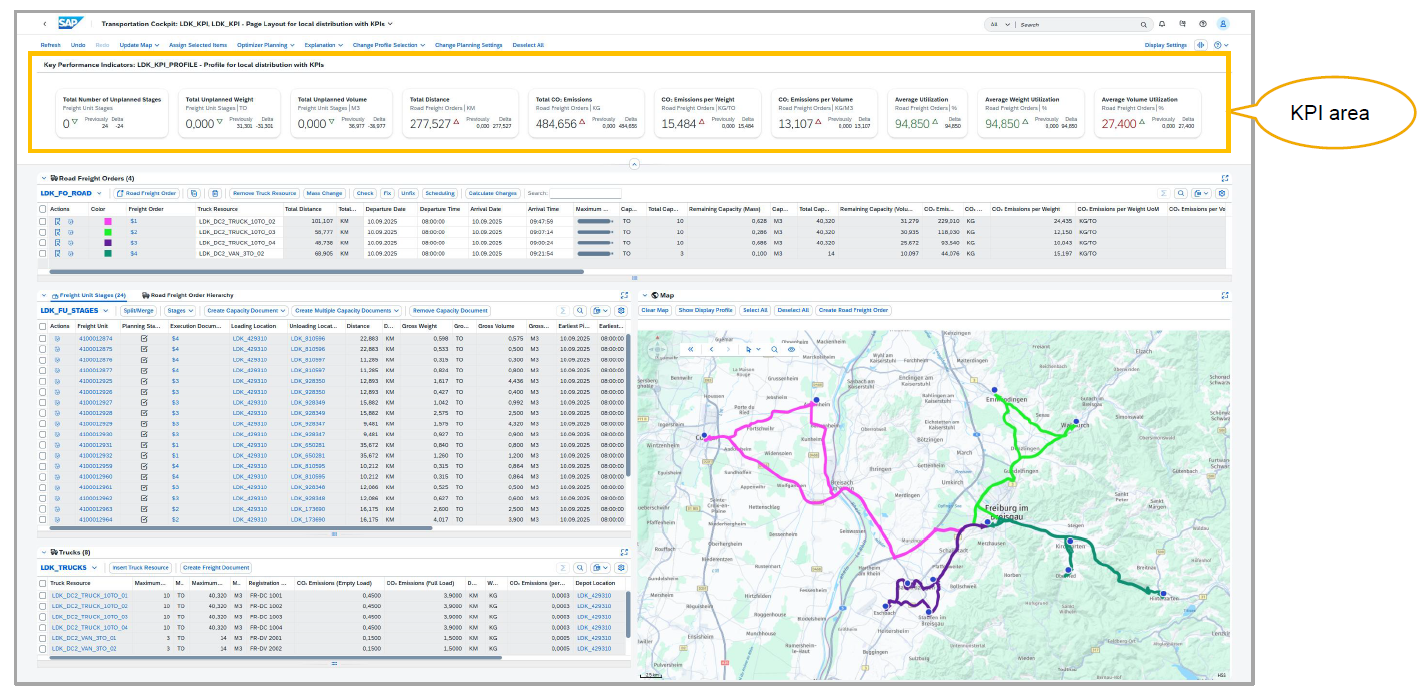
With BN4L and S/4HANA’s Transportation Cockpit (featuring 93 built‑in KPIs), you gain a real‑time overview of:
- Costs
- Utilization
- Distance
- Execution status
- CO₂ emissions
This helps you reduce expedites and unplanned interventions.
Strengthen Freight Settlement Accuracy
SAP TM helps you avoid overcharges and invoice disputes through automated:
- Freight cost calculation
- Accrual generation
- Charge auditing
- Three-way matching
BN4L adds digital invoice submission and self-billing, further reducing errors.
Standardize Logistics Processes
By centralizing rate management, tenders, planning rules, and data, you establish one consistent way of working across your organization.
Drive Sustainability
Freight transportation represents a large share of logistics emissions. SAP TM now:
- Calculates CO₂ emissions by weight and distance
- Considers emissions in planning (VSR optimizer)
- Integrates with SAP Sustainability Footprint Management for Scope 1–3 insights
This makes sustainability part of day‑to‑day operations — not an afterthought.
Faster Decisions with Real-Time Insights
The S/4HANA 2025 release introduced advanced KPI profiles and real‑time recalculation with every planning action. You can evaluate alternatives directly in the Transportation Cockpit without waiting for batch runs.
Deployment Options in 2026
The deployment landscape has evolved quickly. As standalone TM on AnyDB (TM 9.6) approaches the end of its lifecycle, SAP is steering customers toward S/4HANA-based deployments.
1. S/4HANA Private Cloud
- Functionally equivalent to on‑premise
- SAP manages the infrastructure
- S/4HANA 2023 supported until end of 2030
- S/4HANA 2025 supported until end of 2032
2. S/4HANA Public Cloud
Public Cloud TM has matured with semi‑annual feature updates. The 2502 release added:
- Subcontracting process support
- New OData APIs for freight orders and bookings
Live implementations now cover road, ocean, and air — including manual planning, execution, and settlement.
Basic Shipping vs. Advanced Shipping
Basic Shipping (included in S/4HANA Enterprise)
Covers the essentials, similar to classic LE‑TRA:
- Transportation network master data
- Manual tendering and carrier selection
- Basic charge calculation
- Dangerous Goods
- Delivery-based planning
- Basic analytics
Advanced Shipping (additional license)
Unlocks the full strength of SAP TM, including:
- Order‑ and delivery‑based planning
- Optimizer-based planning (VSR)
- CO₂-aware planning
- AI-assisted planning
- Load planning & consolidation
- Carrier tendering (incl. ocean)
- Advanced charge calculation
- ASR integration with EWM
- BN4L connectivity
How SAP TM Integrates with SAP EWM
Since 2021, SAP has modernized the integration between SAP TM and SAP EWM, resulting in three options.
1. Delivery-Based Integration (Legacy)
- Outbound Delivery triggers Freight Unit creation
- Planning assigns Freight Units → Freight Orders
- ODO in EWM is blocked until planning is completed
- Uses Transportation Units (TUs) and LDAP messages
2. Order-Based Integration (Legacy)
- Freight Units generated from Sales Orders
- Transportation planning drives delivery creation
- Prioritizes transportation over warehouse
3. Advanced Shipping & Receiving (ASR) — The New Standard
ASR is now SAP’s strategic direction and brings major improvements:
- No TUs — Freight Order becomes the central object
- Real-time exchange with bgRFC
- Two execution modes: warehouse-first or transportation-first
- Combined inbound & outbound on one Freight Order
- Cross-delivery HU consolidation
- ASR with minimal warehouse master data (S/4HANA 2025 FP01)
- Works in embedded and decentralized setups
The Transportation Cockpit remains central with Gantt planning, resources, 3D load plans, mapping, and KPI dashboards.
How AI and Joule Enhance SAP TM
SAP’s generative AI copilot, Joule, has transformed the planning experience.
In the Transportation Cockpit
Planners can use:
- Text-to-action commands — “Plan all urgent shipments to Belgium.”
- What-if simulations — Adjust weights, compare LTL vs. FTL, test alternative routes.
- Conversational planning — Supports multi-step actions and capacity analysis.
AI Around the TM Landscape
Additional AI capabilities include:
- Predictive demand and delay forecasting
- Smart routing with real‑time traffic/weather
- Carrier selection based on reliability and cost patterns
- ML-driven freight cost optimization
- Anomaly detection for cost discrepancies
- AI-based goods receipt analysis
SAP Business Network for Logistics (BN4L)
BN4L replaces the older LBN/GTT landscape with a unified collaboration and visibility platform. Key capabilities:
- Digital freight collaboration – Tendering, bidding, document exchange
- Global Track & Trace – Milestones, GPS, deviation alerts
- Dock appointment scheduling – Carrier self-booking
- Automated freight settlement – Digital invoices, self-billing
- Material traceability – End-to-end tracking, including blockchain
- Sustainability insights – Emission monitoring and greener routing
BN4L connects seamlessly with SAP TM, SAP EWM, and S/4HANA — and can be used by non‑SAP partners via BTP.
What’s Next for SAP Transportation Management
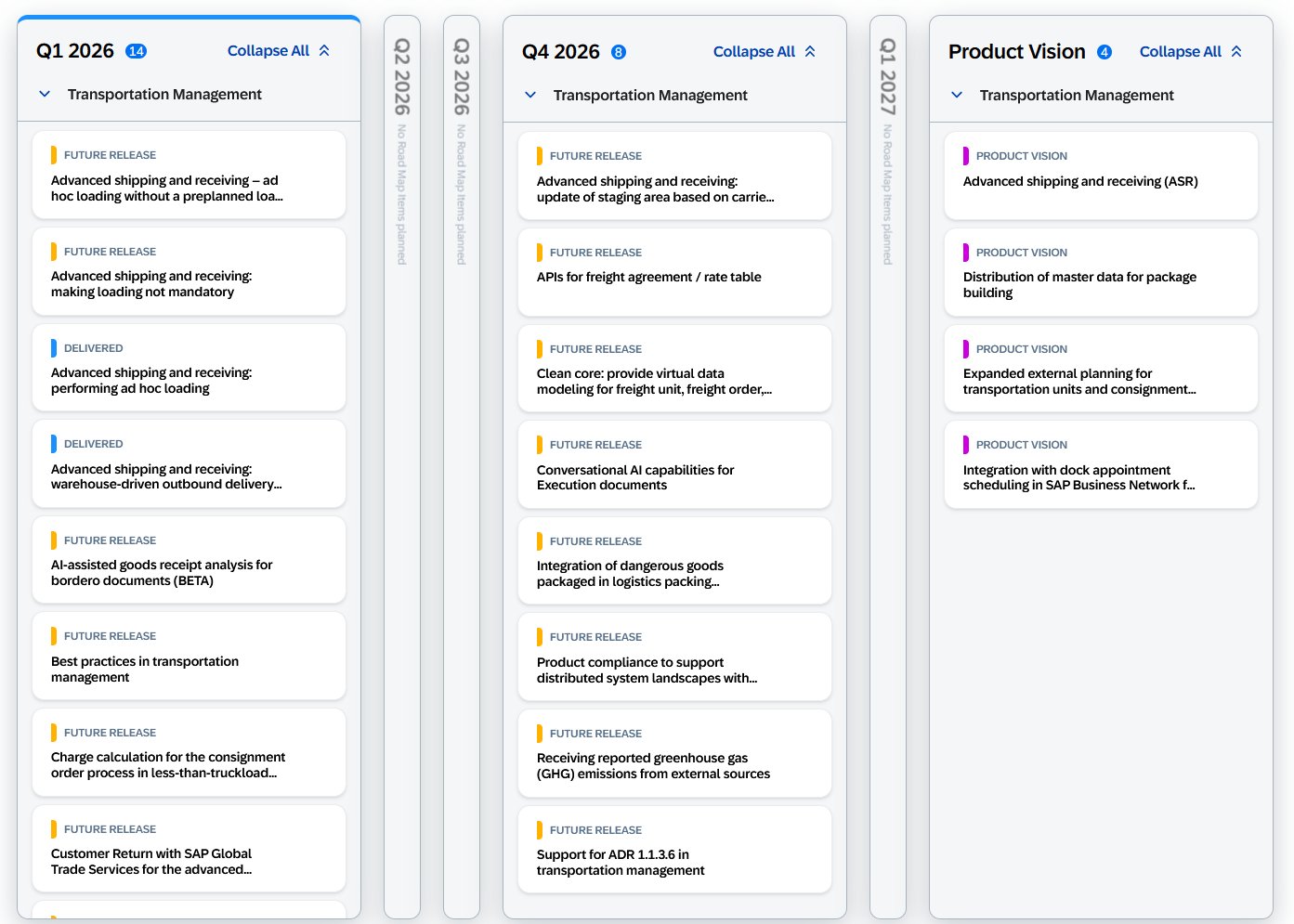
SAP’s roadmap shows several major themes:
- Deeper AI integration — More automated planning and exception handling
- Public Cloud expansion — Bridging feature gaps with Private Cloud
- ASR-first integration — Replacing legacy LDAP/TU-based flows
- Sustainability-by-design — Emission-optimized planning becoming standard
- Migration urgency — ECC support ends 2027; older S/4 releases nearing deadlines
For many organizations, S/4HANA 2025 — supported until 2032 — is the preferred landing zone for future-proof Transportation Management.
Looking to modernize your transportation processes with SAP TM — or unsure which deployment or integration path fits your roadmap?
Get in touch with Quinaptis for guidance, demos, or a tailored assessment of your logistics landscape.
Sources Used for This Blog
- SAP Community Blogs on Transportation Management innovations (S/4HANA 2023, 2025, Public Cloud 2502)
- SAP News Center: SAP Business AI Release Highlights Q4 2024
- Lauterbach, Sauer, Gottlieb, Sürie, Benz (2019). Transportation Management with SAP. Rheinwerk Publishing.
- SAP Roadmap Explorer for Transportation Management