Safety stock is the buffer between you and a dissatisfied customer, but in SAP EWM it can either be your best friend or a very expensive mistake if not managed well. For Benelux supply chain managers working with tight margins and high service expectations, getting safety stock right in EWM is a strategic capability, not just an MRP setting.
What safety stock really is
Safety stock is the extra inventory you hold above expected demand to absorb variability in demand and supply, such as demand peaks, supplier delays, or transport disruptions. In a warehouse context, it protects service levels and process continuity when reality deviates from the forecast.
In SAP environments, safety stock is defined at product/location level as a minimum protection level that should not be consumed by normal planning and is used by MRP and warehouse execution to trigger replenishment before risk of stockout.
Why it matters in Benelux
Benelux networks are typically compact but highly time-sensitive, with dense urban delivery, strict service-level agreements, and frequent cross-border flows. This makes even short stockouts very visible to customers and sales, while excess stock quickly inflates working capital and storage costs in expensive warehouse space.
The right safety stock strategy supports high OTIF performance, stabilizes warehouse workloads, and reduces firefighting, which is critical in mature, high-cost logistics markets like the Netherlands, Belgium, and Luxembourg.
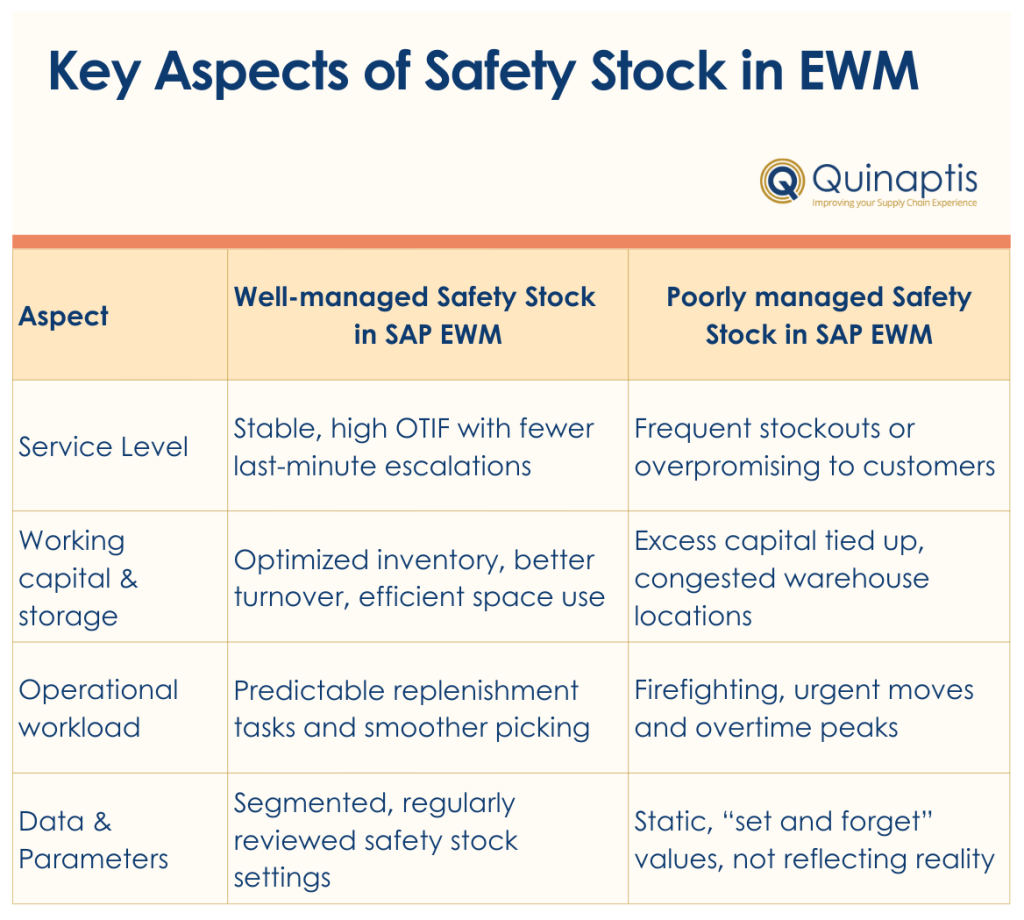
Advantages when managed well in SAP EWM
- Higher service levels: Properly dimensioned safety stock reduces stockouts on A and B items, stabilizing availability despite demand and lead time variability.
- Lower total cost: When aligned with forecasting and planning, optimized safety stock cuts emergency transports, rush orders, and production changeovers, and lowers the overall capital tied up in inventory.
- Better execution in EWM: SAP EWM can leverage safety stock levels to drive warehouse tasks and internal replenishment, ensuring fast-moving pick faces are refilled before they run dry.
SAP also supports different safety stock methods (static, time-dependent days-of-supply, and time-dependent quantities), enabling more granular control over seasonal or volatile products in your EWM-managed locations.
Typical pitfalls and risks
- Overstocking “just in case”: Treating safety stock as a comfort blanket rather than a calculated buffer ties up cash, reduces inventory turnover, and fills prime locations with slow movers.
- Ignoring lead-time variability: Using fixed lead times and static safety stock in EWM, while suppliers and transport are volatile, leads to either hidden stockouts or constant manual overrides.
- Misalignment between ERP and EWM: If safety stock is configured in S/4HANA or ECC but not reflected in EWM control parameters and replenishment logic, warehouse execution may not protect the buffer as intended.
Other common issues include setting the same safety stock logic for all products instead of segmenting (ABC/XYZ), and never revisiting parameters after go-live, which slowly erodes the value of the buffer.
How to make SAP EWM work for you
- Segment and prioritize: Focus advanced safety stock logic on high-value or high-variability SKUs and key Benelux customers, while keeping simpler rules for C-items.
- Use appropriate SAP methods: Combine static safety stock for stable items with time-dependent methods for seasonal or campaign-driven products, leveraging the MRP Safety Stock Method options in SAP.
- Integrate planning and execution: Align your SAP MRP, demand planning, and EWM internal replenishment so that safety stock levels trigger timely warehouse tasks instead of last-minute firefighting.
Conclusion
For supply chain managers, the real differentiator is treating safety stock in SAP EWM as a dynamic lever that is reviewed regularly with sales, procurement, and operations, not as a one-off configuration activity.