Many supply chain teams treat their MRP (Material Requirements Planning) system like a crystal ball. Feed it forecasts, stock levels, lead times, and BOMs, and expect a clean, executable plan to come out the other end.
It doesn’t work that way.
MRP doesn’t think. It calculates. And that distinction matters more than most organisations realise.
What MRP Actually Does
MRP is a calculation engine. It takes the parameters you give it and processes them systematically across your entire bill of materials. Every procurement proposal, every replenishment order, every planned delivery – all of it flows from the data you put in.
That makes MRP incredibly powerful. But it applies the same confidence to an outdated lead time from six years ago as it does to one updated last week. It doesn’t flag the difference. It just calculates.
When Parameters Go Wrong
When your input data is unreliable, MRP will create chaos, even worse: it automates it. Consider what happens when:
- Supplier lead times are out of date: MRP plans on the wrong timeline, leading to late deliveries or excess safety stock
- Stock levels are inaccurate: the system proposes unnecessary replenishments or misses real shortages
- BOMs haven’t been updated: procurement requests are triggered for the wrong materials or quantities
- Lot sizes were set once and never reviewed: you end up with chronic overstock or recurring stockouts
- Forecasts are unstable: MRP amplifies that instability across the entire supply chain
A bad manual process creates isolated errors. A bad MRP multiplies them at scale – automatically.
The Real MRP Challenge: Data Discipline
Running MRP is the easy part. The hard part is maintaining the parameters that make it useful.
In practice, MRP parameters accumulate over years: some correctly maintained, others copied from similar materials, others frozen in place after a one-time tactical decision that was never documented. The system treats them all equally.
Good MRP management starts with knowing which data you can trust, which is approximate, and which is simply unknown. Only from that starting point can your planning team know where to challenge the system’s output and where to rely on it.
That is a process and discipline problem.
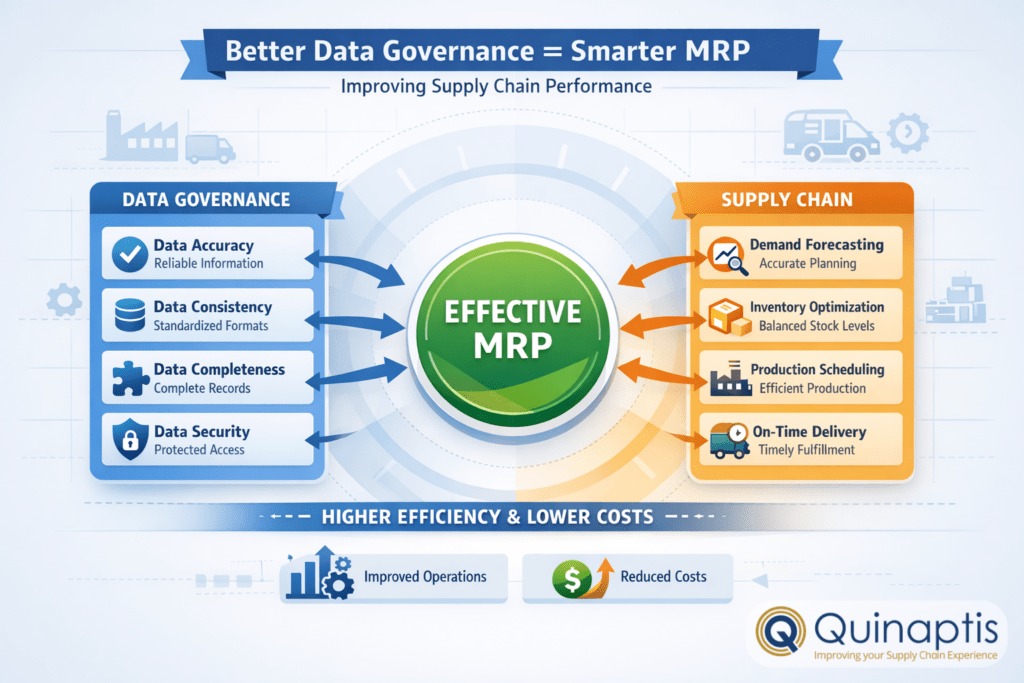
MRP Is a Decision-Support Tool – Not a Decision-Maker
MRP works best when your team understands what it calculates, why it calculates it, and under what conditions its recommendations are reliable. That means:
- Regular parameter reviews: lead times, lot sizes, safety stocks
- Data governance processes: who owns which parameters, how often they are validated
- Planner expertise: the ability to challenge system output, not just approve it
- Cross-functional discipline: procurement, warehouse, and production teams all contribute to MRP input accuracy
The tool makes business judgment more important because the consequences of poor inputs are faster, larger, and harder to unwind.
Can AI Make MRP Smarter?
AI can help but only if you understand what it actually does.
Traditional MRP is a static, rule-based engine. AI can add a dynamic layer on top of it, making your planning more responsive and your parameters more accurate over time. Here is where AI can genuinely add value:
- Smarter demand forecasting: AI models analyse historical sales data, seasonal patterns, and external signals to predict future demand more accurately, reducing the forecast instability that MRP amplifies
- Automatic parameter suggestions: AI can flag when a supplier lead time is drifting away from reality, or when a lot size is generating systematic overstock, and suggest corrections before they cause problems
- Exception handling at scale: AI agents can continuously monitor your entire materials portfolio, surface only the exceptions that need human attention, and free your planners from routine MRP list processing
- Dynamic safety stock optimisation: instead of fixed safety stock levels set years ago, AI can continuously recalculate optimal buffers based on actual demand variability and supplier reliability
In the SAP environment specifically, tools like SAP Joule and agentic AI built on SAP S/4HANA and SAP IBP are already enabling MRP controllers to shift from repetitive transaction work to higher-value planning decisions.
However AI does not fix bad data. If your lead times are wrong, your BOMs are outdated, and your lot sizes have never been reviewed, AI will process those flawed parameters with even greater speed and confidence. As one expert puts it bluntly: a bad process digitalised is still a bad process.
AI amplifies MRP. Which means it amplifies both your strengths and your weaknesses. Getting the data discipline right comes first.
Ready to get more from your MRP?
At Quinaptis, we help logistics and operations teams get more from their SAP supply chain environment – including MRP configuration, parameter governance, and the processes that keep your data reliable over time. If your MRP output feels unpredictable, the problem is rarely the system itself.
→ Contact us to discuss your MRP setup and find out where we can add value.