Summary
Integrating IoT sensing and warehouse robotics with SAP can transform F&B operations—but only if architecture, cybersecurity, and scaling are evidence‑based. This article synthesizes findings from peer‑reviewed research and EU/NIST guidance.
Why this matters now (evidence, not hype)
Across perishable food chains, wireless temperature monitoring enables predictive shelf‑life modelling and shelf‑life–driven distribution, reducing waste—if devices meet realistic reliability thresholds (battery life, ≤10‑minute measurement intervals, data‑loss <~2%) [1]. In the warehouse, AGVs/AMRs deliver throughput and flexibility gains when they are orchestrated by the WMS/EWM layer and supported by accurate location and task data—conclusions reinforced by a 32‑year literature synthesis on flexible warehouse automation [2] and complementary reviews of AMRs in logistics [3]. Meanwhile, RTLS (e.g., UWB) and RFID—integrated with warehouse management—improve visibility on travel, slotting, and congestion, enabling continuous KPI‑driven optimization in cross‑docking and storage operations [4][5].
Implication: The research consensus is clear: sensors + robots only create value when they’re tightly coupled to the warehouse/process control layer (e.g., SAP EWM) that assigns tasks, sequences work, and captures traceability and KPIs [2][3][5].
What “good” looks like in SAP‑centric architectures
– EWM as the control plane for robotics. SAP’s patterns—either direct robot integration or fleet‑manager integration—keep warehouse orders authoritative in EWM while providing real‑time robot/task monitoring via SAP BTP (Warehouse Robotics) [6][7]. This aligns with literature stressing that robotics must be treated as an extension of WMS/EWM orchestration, not a bolt‑on island [2][3].
Learn more:
– IoT data your shelf‑life model can trust. Cold‑chain studies show benefits materialize only when device capabilities (intervals, accuracy, loss rates, battery life) match the predictive model’s assumptions and are embedded into operational routines [1].
Need help? Cold‑Chain Compliance Assessment
– Location intelligence for flow decisions. UWB‑based RTLS paired with EWM improves KPI quality (utilization, travel, congestion), enabling layout/slotting changes that measurably affect throughput—documented in learning cross‑docks and reviewed broadly in production logistics [4][5].
The uncomfortable (but necessary) questions to ask
1) Can we secure this like critical OT, not just IT?
IoT and robotics expand the attack surface deep into operational technology (OT). ENISA recommends zero‑trust identity, OT network segmentation, asset governance, and monitoring for smart‑manufacturing IoT/Industry 4.0 rollouts [8][9]. NIST SP 800‑82r3 (2023) remains the go‑to for OT security controls, emphasizing availability/safety, segmentation, allow‑listing, and anomaly detection tailored to industrial/warehouse control contexts [10].
2) Will it scale under variability?
Peer‑reviewed syntheses highlight that throughput gains depend on task orchestration, fleet coordination, and layout constraints—not just robot counts. Simulation and data‑backed scenario design should precede rollout to avoid congestion and under‑utilization traps [2][3]. For IoT, published requirements on measurement intervals, data loss, and device durability are the difference between actionable and noisy cold‑chain data [1].
3) Are we measuring ROI in a way the board will sign off?
Independent guidance stresses a structured ROI/TCO approach (not vendor payback slides). In Flanders, VIL provides decision tools (with University of Antwerp) to quantify automation economics (labour substitution, project costs, 10‑year cash flows) for loading/unloading—adaptable to warehouse automation scenario analysis [11]. Strategy research shows programs succeed when they sequence use‑cases, fix processes/data before automation, and invest in change management and governance—else financial benefits underperform [12].
A pragmatic, evidence‑aligned roadmap
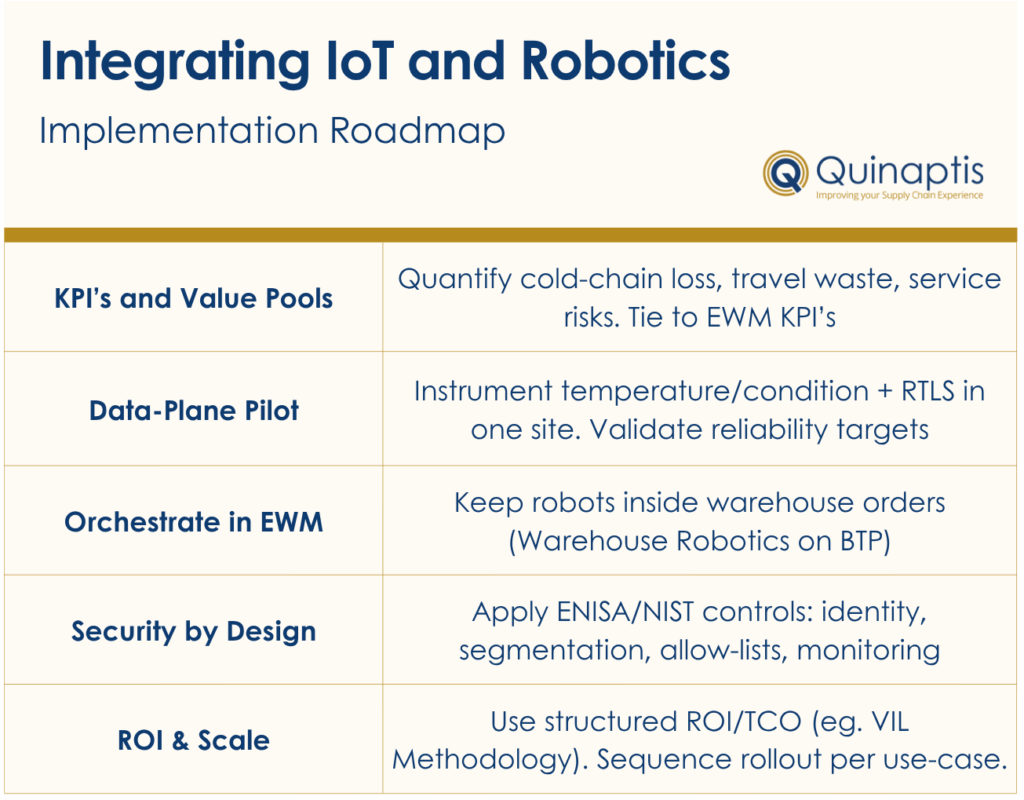
- Start with value pools anchored in KPIs. Quantify cold‑chain losses, travel waste, labour volatility, and service risks—and tie each to a measurable KPI and an EWM touchpoint (task times, replenishment, compliance). Cold‑chain and RTLS literature is explicit about which measurements matter and at what cadence [1][4][5].
- Prove the data plane before the robot plane. Pilot wireless sensing (temperature/condition) and RTLS where they materially affect shelf‑life or travel. Validate that data reliability targets and device lifetimes hold under actual operations—then feed those signals into EWM logic [1][4].
- Keep robots inside EWM orchestration. Use SAP’s Warehouse Robotics patterns to dispatch/monitor warehouse orders and avoid “shadow orchestration.” This mirrors research findings on the centrality of WMS/EWM in achieving real performance gains [2][6][7].
- Build security in from day one. Map controls from ENISA and NIST SP 800‑82r3 to the architecture (device identity, network segmentation, logging/anomaly detection, incident playbooks). Budget for OT patching and vulnerability management as non‑optional [8][9][10].
- Model ROI with independent structure. Apply ROI/TCO tools (e.g., VIL‑style methodology) to compare manual vs. sensor‑enhanced vs. robotics scenarios, including energy, maintenance, security operations, and resilience. Align assumptions to the measurement requirements in [1] and to orchestration constraints in [2][3][5][11][12].
Conclusion
The research is remarkably consistent: you don’t buy value—you design it. In F&B, IoT sensing cuts waste when it meets specific reliability thresholds and is embedded in operations; robotics pay off when governed by the warehouse control layer with security and scaling engineered from the outset. Treat IoT + robotics integration as an enterprise architecture decision tied to SAP EWM—not a gadget procurement.
Ready to pressure‑test your plan?
Talk to our integration architects
References
[1] Lamberty, A.; Kreyenschmidt, J. (2025). Technical, process‑related and sustainability requirements for IoT‑based temperature monitoring in fruit & vegetable supply chains. Discover Food Research (Springer, open access). https://link.springer.com/content/pdf/10.1007/s44187-025-00427-1.pdf
[2] Ellithy, K.; Salah, M.; Fahim, I.S.; Shalaby, R. (2024). AGV and Industry 4.0 in warehouses: a comprehensive analysis & framework for flexible automation. The International Journal of Advanced Manufacturing Technology (open access). https://link.springer.com/content/pdf/10.1007/s00170-024-14127-0.pdf
[3] Keith, R.; La, H. (2024). Review of Autonomous Mobile Robots for the Warehouse Environment. arXiv:2406.08333 (open access). https://arxiv.org/pdf/2406.08333
[4] Pilati, F.; Sbaraglia, A.; Regattieri, A.; Cohen, Y. (2021). Real‑time locating system for a learning cross‑docking warehouse. University of Trento / University of Bologna (open access). https://cris.unibo.it/bitstream/11585/865147/1/SSRN-id3861702%20%281%29.pdf
[5] Rácz‑Szabó, A.; Ruppert, T.; Bántay, L.; Löcklin, A.; Jakab, L.; Abonyi, J. (2020). Real‑Time Locating System in Production Management. Sensors 20(23), 6766 (open access). https://www.mdpi.com/1424-8220/20/23/6766
[6] SAP Help Portal. SAP Warehouse Robotics (overview & integration patterns). https://help.sap.com/docs/WAREHOUSE_ROBOTICS/013f13725b1e472d918963da19495ff0
[7] SAP Community. SAP Warehouse Robotics 2305: fleet‑manager & direct integration monitoring. https://community.sap.com/t5/supply-chain-management-blog-posts-by-sap/sap-warehouse-robotics-2305/ba-p/13557790
[8] ENISA (2018). Good Practices for Security of IoT in the Context of Smart Manufacturing. https://www.enisa.europa.eu/publications/good-practices-for-security-of-iot
[9] ENISA. Industry 4.0—Cybersecurity: Challenges & Recommendations. https://www.enisa.europa.eu/sites/default/files/publications/Industry%204.0%20-%20Cybersecurity%20Challenges%20and%20Recommendations.pdf
[10] NIST (2023). SP 800‑82r3 — Guide to Operational Technology (OT) Security. https://nvlpubs.nist.gov/nistpubs/SpecialPublications/NIST.SP.800-82r3.pdf
[11] VIL (Flanders Institute for Logistics) & University of Antwerp (Carlan, Van Hassel, Vanelslander). ATL/Automation ROI methodology (OptiCharge ROI Manual). https://toolbox.vil.be/pdf/download/EJNVJ
[12] McKinsey (2023). Getting warehouse automation right: maximize ROI. https://www.mckinsey.com/capabilities/operations/our-insights/getting-warehouse-automation-right