What is the implication of AI for warehouse management? For decades, the Warehouse Management System has been the undisputed operational brain of modern logistics. It manages inbound receiving, put-away, storage, picking, outbound delivery, and inventory tracking. Without a WMS, even a well-organized warehouse quickly loses accuracy, traceability, and flow. SAP Extended Warehouse Management (EWM), in particular, has long been the go-to standard for complex, high-throughput warehouse environments.
But a major shift is underway and the clearest signal came from SAP Sapphire in May 2026.
AI will not replace WMS but it is fundamentally repositioning it. SAP EWM is evolving from a rules-based execution engine into an AI-orchestrated logistics platform, driven by Joule agents, predictive labor planning, and real-time optimization capabilities announced at SAP Sapphire 2026.
SAP No Longer Calls Itself a Software Company
At SAP Sapphire 2026, CEO Christian Klein stepped on stage and made a statement that would have seemed radical just a few years ago: SAP is no longer a software company. It is becoming a business AI company. Klein announced the SAP Business AI Platform and introduced the concept of the Autonomous Enterprise, a vision in which AI agents run critical business workflows while humans focus on strategy, oversight, and judgment.
“We’re bringing together LLMs with 50 years of business know-how stored in our ERP,” Klein said. “To do this, we had to do nothing less than completely reinvent our company.”
The ambition is enormous. The SAP Autonomous Suite spans five domains (Finance, Spend, Supply Chain, HCM, and CX) and includes more than 200 agents and over 50 role-based Joule Assistants. The supply chain domain, which covers planning, manufacturing, logistics, and asset management, is one of the first areas where these AI capabilities are being deployed at production scale.
This is not just a roadmap announcement. It is happening now.
What This Means for SAP EWM
The practical implications for warehouse operations are significant and already visible in recent SAP releases.
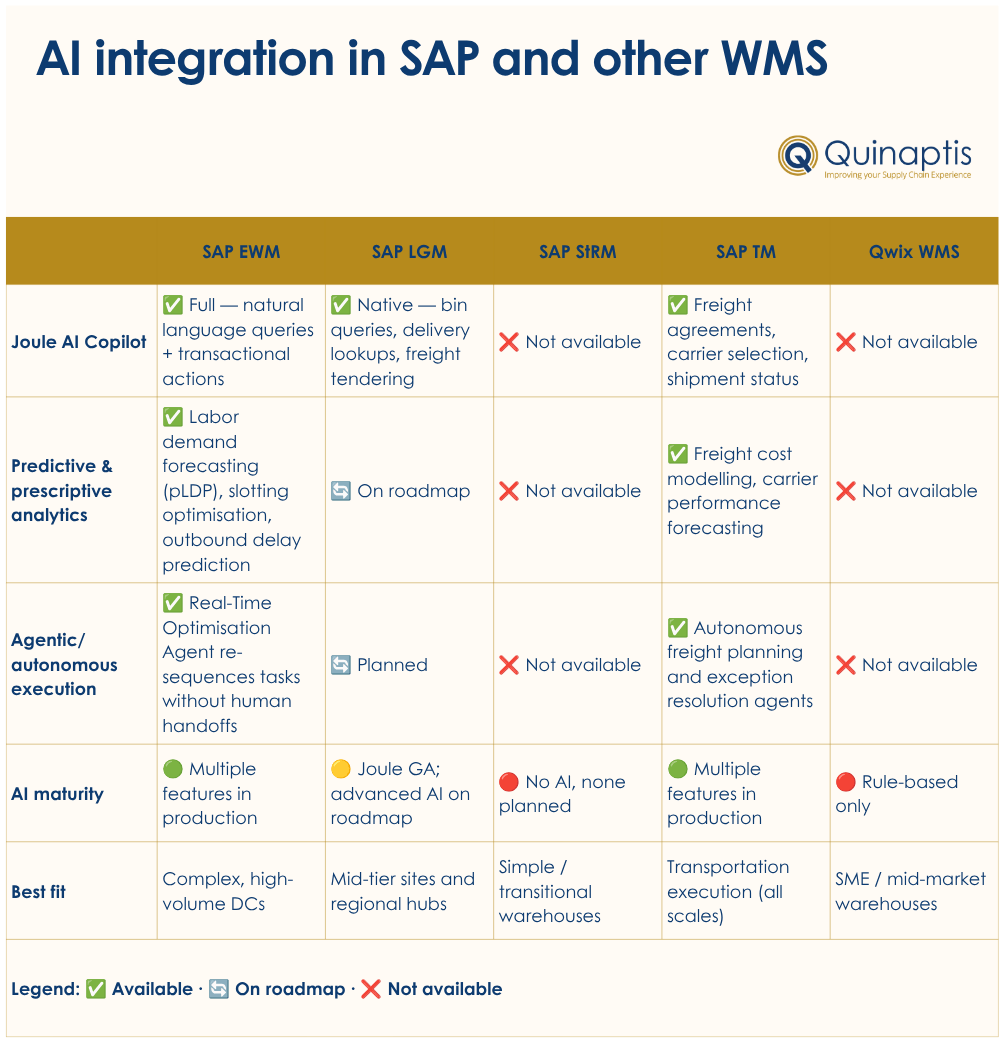
The centrepiece of SAP’s warehouse AI story is Joule, SAP’s generative AI copilot. Joule is now embedded directly into SAP EWM, allowing warehouse supervisors and planners to ask natural language questions such as “Will today’s outbound targets be met?” or “Which zones are underutilised?” and receive immediate, actionable answers, without navigating dashboards or waiting for reports. Beyond information retrieval, Joule can now perform transactional actions in EWM outbound processes: creating and confirming warehouse tasks, setting shipping readiness status (integrated with SAP TM), and posting or reversing goods issues.
One of the most impactful recent features is AI-assisted Predictive Labor Demand Planning (pLDP), available in SAP S/4HANA Cloud Private Edition. Using a triple exponential smoothing algorithm in SAP’s Predictive Analysis Library, EWM now learns from historical executed workload to forecast future labour needs across picking, packing, and staging activities. The system requires no external data training: it simply activates, learns, and begins forecasting. Warehouse operations managers can see predicted workload, identify capacity gaps before they occur, and accept AI-generated resource reallocation recommendations with a single action.
The EWM Real-Time Optimization Agent, announced at SAP Sapphire 2026 as part of the Autonomous Supply Chain Management initiative, takes this further: it continuously re-sequences warehouse tasks in real time based on shifting conditions. A Logistics Assistant, one of six new Joule Assistants for supply chain, is designed specifically to keep warehouse and transportation execution moving as conditions change, coordinating agents rather than waiting for human handoffs.
SAP Logistics Management: AI from Day One
When SAP launched SAP Logistics Management (LGM) in October 2025, it did not just add another tier to its warehouse portfolio, it built a cloud-native logistics platform with AI embedded from the start .
LGM is designed for the estimated one-third of warehouses worldwide still managed on spreadsheets or paper, where EWM would be overkill . It unifies warehouse execution, transportation execution, and carrier collaboration in a single SaaS solution on SAP BTP, handling simpler logistics environments such as satellite warehouses, regional hubs, or production-adjacent stockrooms . But what distinguishes LGM from its predecessors is how central AI is to the user experience.
Joule is available natively within SAP Logistics Management, and this is where the interaction model becomes genuinely different . Rather than navigating multiple Fiori applications to answer a basic operational question, logistics clerks can simply ask: “How many bins are currently within scope for this warehouse?” or “Which flows are trending toward delay?” . Joule handles storage bin queries, freight tendering, pickup schedule creation and querying, and delivery document lookups, all through natural language . The result is that even logistics teams without deep SAP system knowledge can work effectively from day one, dramatically reducing both the training burden and the adoption barrier .
This is a deliberate strategic signal from SAP. In the Autonomous Enterprise architecture, visibility becoming conversational is not a premium add-on for complex EWM implementations. It is the baseline for every tier of the warehouse portfolio, including the lightest . For enterprises managing a mix of a large central distribution centre running EWM and several smaller regional sites, LGM means those satellite locations can now participate in the same AI-driven operational model, without requiring a full EWM rollout at each one. The intelligence is consistent across the network, even where the logistics complexity is not.
Where StRM and SAP TM Fit In
Not every warehouse needs the full complexity of SAP EWM. For companies running simpler, manual logistics processes, particularly those migrating from legacy SAP WM to S/4HANA, SAP Stock Room Management (StRM) offers a lean, cost-efficient continuation of core warehouse functions. It handles bin management, stock transfers, goods receipt and issue, and mobile device support within S/4HANA. However, StRM receives no further development from SAP and has no AI capabilities on its roadmap. For organizations that want to stay competitive in an AI-driven logistics world, StRM is best understood as a transitional bridge toward EWM or LGM, not a destination.
At the transportation layer, SAP TM (Transportation Management) is increasingly intertwined with warehouse operations through the Advanced Shipping & Receiving (ASR) integration with EWM. The Joule Logistics Assistant bridges both domains, managing real-time coordination between inbound shipments, dock scheduling, and warehouse task sequencing. In the Autonomous Enterprise model, the boundary between TM and EWM becomes more fluid, with AI agents orchestrating decisions across both systems without requiring manual intervention at each handoff point.
The WMS Landscape Beyond SAP
SAP is not the only player rethinking what a WMS should be in the age of AI, and it is worth understanding the broader competitive landscape.
Traditional, standalone WMS solutions face growing pressure to incorporate intelligence, not just automation. Systems like Qwix WMS, a cloud-based warehouse management platform that integrates with ERP systems including SAP, SYSPRO, and Sage, represent the category of agile, configurable WMS tools that appeal to mid-market companies. Qwix offers dynamic workflow management, mobile device support, electronic proof of delivery (EPOD), and real-time inventory visibility. Platforms like this demonstrate that operational excellence in warehouse management does not require a full SAP implementation, but they also underline how much competitive pressure there now is to embed predictive and prescriptive intelligence into every layer of the WMS stack.
The honest question is not whether smaller WMS platforms can compete on features today, but whether they can keep pace with the AI investment being made by hyperscalers and enterprise ERP vendors. According to McKinsey research cited by SAP, “companies that have already embraced AI in their supply chains are seeing 15% lower logistics costs, a 35% reduction in inventory levels, and up to 65% improvement in service levels.” These are not marginal gains.
The Architecture Is Changing, Not Just the Features
Here is what the SAP Sapphire 2026 announcements signal at a structural level: the WMS, as a standalone rule-based execution engine, is gradually being repositioned.
In the emerging architecture, EWM becomes the execution layer, the trusted transactional system of record for all physical warehouse movements. Above it sits the AI layer: Joule Assistants and specialized agents that sense, reason, predict, and act. These agents do not replace EWM; they make it dramatically more responsive. The rules-based logic that historically required months of configuration is increasingly replaced or augmented by machine learning models that adapt continuously to real operational data.
When a traditional WMS is calculating the optimal pick path, an AI-enabled EWM is simultaneously predicting whether today’s workforce is sufficient to meet tomorrow’s outbound commitments, flagging inbound quality deviations via sensor data, and proposing slotting changes based on evolving demand patterns. These are qualitatively different capabilities and they are now available in production environments, not just proof-of-concept pilots.
Will Your WMS Keep Up with AI?
The original question, “Can AI replace WMS?” was always slightly off-target. A more useful question is this: will your WMS platform be able to host the AI capabilities that modern logistics requires?
For large, complex distribution operations, the answer increasingly points to SAP EWM, especially given SAP’s declared ambition to embed agentic AI across every core warehouse process. For simpler warehouses in transition, LGM seems a valid alternative and StRM remains a viable interim solution. For companies that operate outside the SAP ecosystem, the pressure to add predictive and autonomous capabilities is just as real but the path is less clear.
What is certain is that the transformation SAP described at Sapphire 2026 is not a future state. The Production Planning Agent is live. The EWM Real-Time Optimization Agent is in deployment. Joule is processing outbound transactions. The shift from a reactive, rules-based warehouse execution system to a proactive, AI-orchestrated logistics platform is already underway.
The question is no longer whether AI will reshape warehouse management. The question is whether your organization will be among the first to benefit or one of the last to adapt.
Quinaptis is specialized in SAP supply chain solutions, with an emphasis on SAP Extended Warehouse Management (EWM). Contact us to learn how the new AI capabilities in SAP EWM can benefit your logistics operations.
Sources:
https://news.sap.com/2026/05/sap-sapphire-keynote-business-ai-platform-power-autonomous-enterprise/
https://rev-trac.com/articles/sap-autonomous-enterprise-key-notes-of-change-from-sapphire-2026/
https://news.sap.com/2026/05/sap-sapphire-sap-unveils-autonomous-enterprise/
https://news.sap.com/2026/05/more-autonomous-supply-chain/
https://www.savictech.com/insights/sap-supply-chain-agentic-ai-ibp-ewm-2026/
https://www.fis-gmbh.de/en/sap-wiki/sap-stock-room-management/
https://www.xeptum.com/en/sap-stock-room-management-successor-or-interim-solution/
https://www.4flow.com/blog/sap-ewm-integration-of-automation-capabilities
https://www.orbis-group.com/en-nl/sap-consulting/supply-chain-management/stock-room-management.html
https://www.qwix.net/products/warehouse-management/
https://warehousemanagement.co.za
https://www.sap.com/events/sapphire.html
https://d.dam.sap.com/x/ZfTkSKh/innovation_story.pdf?rc=19&inline=true
https://www.sap.com/topics/events/sapphire/innovation-news-guide-2026
https://www.sap.com/assetdetail/2024/07/deacd3da-007f-0010-bca6-c68f7e60039b.html
https://leverx.com/newsroom/ai-in-sap-ewm
https://www.youtube.com/watch?v=1uK9k457TWE
https://www.linkedin.com/products/qwix-mobile-solutions-wms-warehouse-management-systems/
https://www.valantic.com/en/research/sap-study-2026/
https://www.oracle.com/europe/scm/ai-warehouse-management/
https://www.linkedin.com/pulse/what-i-learned-sap-sapphire-2026-year-enterprise-ai-grew-bornet-jxpse
https://www.sap.com/blogs/supply-chain-trends-for-2026-from-agentic-ai-to-orchestration
https://www.generixgroup.com/en/blog/the-role-of-ai-and-machine-learning-in-modern-wms
https://www.valantic.com/en/events/sap-sapphire/
https://www.youtube.com/watch?v=t_hIhN1Zqgo
https://westernacher.com/events-webinars/bring-it-on-at-sap-sapphire-in-2026/
https://www.gambit-group.com/de/en/wiki/sap-stock-room-management/