Choosing a warehouse management system (WMS) is one of the most important supply chain decisions a company can make. The right solution can improve inventory accuracy, increase productivity, support future growth and operational change, and provide the visibility needed to make better business decisions. The wrong choice can create years of operational frustration, unnecessary complexity, and avoidable costs.
We’ve seen companies spend hundreds of thousands of euros on a new WMS and still struggle with inventory accuracy six months later. Often the reason is the unspoken assumption that warehouse problems can be solved by technology alone.
Yet many organisations approach warehouse management projects in the wrong way: They start by comparing software products.
Should we implement SAP EWM? Is SAP LGM sufficient? Would a lighter system such as Qwix WMS be a better fit? Which vendor has the most features? Which platform is most popular?
These questions are understandable, but they are rarely the best starting point.
At Quinaptis, we believe warehouse management projects should start with the business, not with the technology. As supply chain specialists with deep expertise in warehouse operations, we help organisations evaluate, implement, support, and continuously improve the solutions that best fit their specific situation, whether that involves SAP EWM, SAP Logistics Management (LGM), Qwix, or another approach altogether.
Warehouses Don't Operate in Isolation
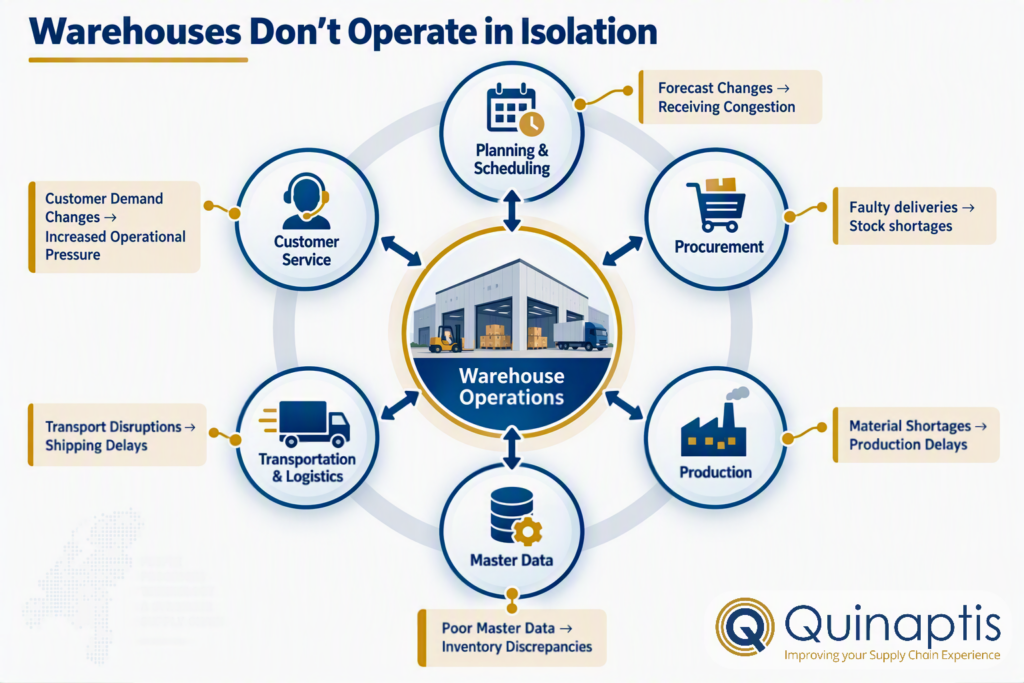
One of the biggest misconceptions surrounding warehouse management projects is that they are standalone software initiatives. In reality, every warehouse sits at the centre of a much larger supply chain ecosystem.
When problems occur inside a warehouse, the root cause may be found elsewhere in the supply chain, although operational and process issues within the warehouse itself should never be overlooked. Consider a few common examples:
- Receiving teams become overloaded because procurement schedules are inaccurate.
- Inventory discrepancies arise due to poor master data quality.
- Production experiences downtime because materials are unavailable when required.
- Order fulfilment slows down because transportation planning changes at the last minute.
- Customer service struggles because stock visibility cannot be trusted.
- Warehouse productivity decreases because material handling equipment or automation assets are unavailable or poorly maintained.
From the warehouse floor, these challenges may appear to be warehouse problems. However, they often originate in procurement, planning, production, transportation, maintenance, or data management.
We’ve encountered situations where a warehouse team in Belgium was repeatedly blamed for inventory inaccuracies, only to discover that the root cause was inconsistent material master data maintained across multiple ERP systems. In one case, more than 70% of recurring inventory discrepancies could be traced back to master data quality issues rather than warehouse execution itself.
This is why warehouse management is about far more than warehouse management software.
A warehouse project is ultimately a supply chain transformation project. It affects processes, people, data, systems, and organisational responsibilities across multiple departments. Companies that recognise these connections tend to make better investment decisions and achieve more sustainable results.
Unfortunately, many companies struggle to find a partner who can see the complete picture.
Software vendors naturally focus on their own products. Technical implementation partners may concentrate primarily on configuration and project delivery. Internal teams are often occupied with daily operational challenges. What is frequently missing is a partner who understands how these different elements influence one another and how decisions in one area affect the rest of the supply chain.
That broader perspective is where Quinaptis positions itself differently: Rather than starting with technology, we start with business processes, operational objectives, and supply chain performance. The technology discussion comes afterwards, once the requirements are fully understood.
Why There Is No Universal Best WMS
- Warehouse complexity
- Business growth plans
- Existing system landscape
- Process maturity
- Automation requirements
- Available budget
- Internal expertise
- Long-term support capabilities
When SAP EWM Makes Sense
SAP Extended Warehouse Management (SAP EWM) is one of the most powerful warehouse management platforms available. It is designed for businesses with demanding logistics requirements and can support highly sophisticated warehouse operations. SAP EWM is often a strong fit for companies that:- Operate multiple warehouses
- Require advanced process control
- Use significant warehouse automation
- Need complex inbound and outbound process management
- Already rely heavily on SAP across their enterprise landscape
- Require extensive configurability and scalability
When SAP LGM May Be a Better Choice
Not every company requires the full capabilities of SAP EWM. SAP Logistics Management is a newer cloud-native logistics platform designed for businesses with relatively standard warehouse and transport activities. For many companies, it can provide a faster-to-deploy and more standardised alternative, although it is not intended to replicate the full breadth of advanced capabilities available in SAP EWM. It allows organisations to benefit from modern warehouse processes while maintaining a more manageable level of complexity. For businesses with relatively straightforward warehouse operations, the additional investment required for a full EWM implementation may not always be justified. The objective should never be to buy the most powerful software. The objective should be to implement the solution that best supports the business.Why Qwix Deserves Consideration
Many Belgian and Dutch companies operate in an environment that differs significantly from the large multinationals often featured in software vendor success stories. For these businesses, flexibility, usability, implementation speed, and ease of maintenance are often more important than having every advanced warehouse feature imaginable. For example, a regional distributor operating two warehouses in Belgium may have fewer than 20 warehouse users and limited internal IT capacity. In this environment, implementation speed, ease of support, and rapid user adoption can deliver more value than advanced functionality that may never be used. This is where systems such as Qwix WMS can play an important role. For SMEs with relatively standard warehouse operations, a software such as Qwix WMS may provide sufficient functionality while reducing implementation complexity and ongoing support requirements. The conversation should therefore never be about selecting the most sophisticated product. It should be about selecting the solution that conforms best with operational reality, available resources, and long-term business goals.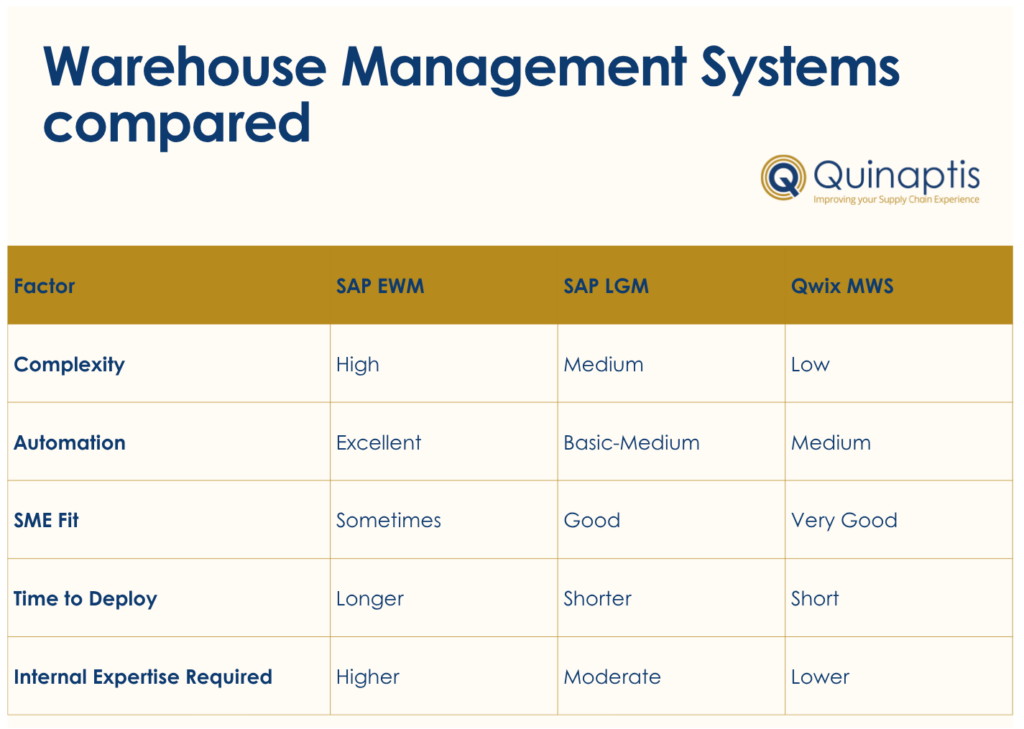
Understanding the Benelux Reality
Much of the advice available online assumes an enterprise environment with large project teams, substantial IT budgets, and extensive internal SAP expertise. The reality in Belgium and the Netherlands is often very different.
Many companies in the Benelux region operate from logistics hubs around Antwerp, Rotterdam, Eindhoven, and Liège. These organisations often serve multiple countries from a limited number of distribution centres, creating a combination of multilingual operations, cross-border transport requirements, and strong pressure on warehouse productivity.
These characteristics create unique challenges.
Multilingual Operations
Many Benelux companies operate simultaneously in Dutch, French, and English. Some organisations must also support German-speaking users. It’s also common for warehouse operators to have a different native language.
A warehouse solution that appears straightforward during demonstrations can become significantly more complex when user training, documentation, labels, handheld devices, and reporting need to support multiple languages consistently.
Limited Internal Resources
Large multinational corporations often have dedicated SAP competence centres and sizeable project teams. Many SMEs do not.
Key users frequently combine operational responsibilities with project activities. Warehouse managers are expected to continue running the business while helping design future processes. IT teams often support numerous business applications simultaneously.
In many SME projects, the warehouse manager, key user, and process owner are effectively the same person. Expecting that individual to spend several days per week on project activities while maintaining daily operations can introduce significant project risk if not properly managed.
Implementation approaches need to reflect this reality.
Pragmatism Over Complexity
In the Benelux market, organisations often value practical, maintainable softwares over theoretical perfection. Many businesses are family-owned.
A solution that solves 95% of business demands while remaining easy to support may generate greater business value than a highly customised system that requires extensive specialist knowledge.
That is why technology selection should always consider not only current operational needs, but also future maintainability and ownership costs.
The Quinaptis Approach: Advisory, Projects and Long-Term Partnership
Rather than approaching warehouse management as purely a technology challenge, Quinaptis supports its customers across three complementary domains.
Advisory: Making Better Decisions Before Investing
Many project challenges can be traced back to decisions that were made too early or with insufficient information.
Selecting software before understanding warehouse requirements. Choosing an architecture before evaluating growth plans. Defining a project scope before assessing data quality.
These decisions can become expensive later.
Most warehouse projects do not fail during implementation. They fail because assumptions made during the selection phase turn out to be wrong. That’s why we invest heavily in the advisory phase. This includes analysing warehouse operations, understanding supply chain dependencies, evaluating future growth plans, reviewing system landscapes, and assessing available technology options.
We’ve participated in projects where several months of implementation effort could have been avoided through earlier process analysis and data assessment. In our experience, identifying major process gaps before software selection can reduce project rework significantly and improve user adoption after go-live.
The goal is simple: make informed decisions early and reduce avoidable project risks. See also our page on business insights.
Projects: Turning Strategy into Reality
Once the right direction has been identified, implementation becomes the next challenge.
Successful projects require far more than software configuration.
Process design, change management, testing, data preparation, integration, training, governance, and business adoption all play critical roles.
Depending on business demands, our project involvement may include:
- SAP EWM implementations
- SAP LGM projects
- Qwix deployments
- Warehouse process redesign
- Supply chain integration initiatives
- Data migration preparation
- Test management
- Go-live support and stabilisation
Equally important, we consider the impact of warehouse decisions on production, transportation, maintenance, and other supply chain processes. This broader perspective helps ensure that warehouse improvements support organisational goals rather than creating new bottlenecks elsewhere. You’ll find more information about this on our Supply Chain & ERP page.
Long-Term Partnership and Continuous Improvement
Go-live is not the end of the journey. In many cases, it is only the beginning. One manufacturing customer introduced wave picking with handheld scanners during the initial implementation, but only realised the full value of the platform two years later after introducing new replenishment strategies and warehouse KPI reporting. Continuous improvement often delivers greater value than the original implementation itself.
Business needs evolve. New products are introduced. Warehouses expand. Processes mature. Teams change. Customer expectations increase.
As these changes occur, systems must evolve alongside them. We therefore see our role not just as a project supplier, but as a long-term partner.
After implementation, businesses often need ongoing support with:
- User questions
- Process optimisation
- New business requirements
- Additional functionality
- User training
- Operational improvements
- System health reviews
- Continuous enhancement initiatives
The most successful warehouse environments are rarely the result of a single implementation project. They are the outcome of continuous improvement over many years.
What to Look for in a Warehouse Management Partner
Choosing the right software matters. Choosing the right partner matters even more. The partner you select will influence not only project success but also long-term adoption, supportability, and future flexibility. When evaluating candidates, consider the following factors.
Industry Understanding
Warehouse operations vary significantly across industries. A manufacturing company faces different challenges than a wholesaler. Food and beverage businesses operate under different constraints than life sciences organisations. Third-party logistics providers have very different requirements from industrial manufacturers.
Look for a partner who understands the realities of your industry, not just the technical platform.
Knowledge of the Wider Supply Chain
Warehouse challenges are often symptoms rather than root causes.
Poor inventory accuracy might originate in master data management. Deliveries arriving late may result from planning issues. Picking inefficiencies could be linked to production scheduling constraints.
A strong partner understands these relationships and can identify issues beyond the warehouse itself.
Technology Independence
Be cautious when every customer receives the same recommendation. A good advisor should be able to explain:
- When SAP EWM is the right choice
- When SAP LGM may be sufficient
- When Qwix offers a better fit
- The trade-offs associated with each option
Technology should be selected because it suits the business, not because it happens to be the preferred platform of the implementation partner. Evaluation criteria should include functional fit, implementation risk, total cost of ownership, scalability, integration requirements, supportability, and the availability of internal skills.
Commitment Beyond Go-Live
Warehouse management systems are long-term investments. Selecting a partner only for the implementation phase can create challenges later.
The strongest partnerships support companies throughout the full lifecycle:
- Assessment
- Selection
- Implementation
- Optimisation
- Continuous support and improvement
The Real Question Isn't Which WMS to Choose
Many companies begin by asking:
“Should we implement SAP EWM?”
In our experience, that’s often the wrong question. The more important questions are:
- What challenges are we trying to solve?
- How will our business evolve over the coming years?
- Which operational processes create the most value?
- What level of complexity can we realistically support?
- Which platform best aligns with our resources, ambitions, and supply chain strategy?
Only after answering these questions does the software discussion become meaningful.
Sometimes the answer will be SAP EWM.
Sometimes it will be SAP LGM.
Sometimes it will be Qwix.
And occasionally, it may be something else entirely.
The goal is to create a warehouse environment that supports your business today while remaining flexible enough to support tomorrow.
The organisations that achieve the best warehouse results are rarely the ones that buy the most software. They’re the ones that understand their processes, their people, and their long-term ambitions before making technology decisions.
Not Sure Which Warehouse Management Software Fits Your Business?
If you’re evaluating a warehouse management system, planning an SAP migration, struggling with an existing warehouse environment, or simply looking for an independent perspective, start with your business requirements rather than the software shortlist.
At Quinaptis, we combine warehouse expertise with broader supply chain knowledge to help organisations make informed decisions, implement practical solutions, and continuously improve their operations over time.
Whether you’re considering SAP EWM, SAP LGM, Qwix, or another approach, we’ll help you understand the trade-offs, assess the impact on your wider supply chain, and identify the solution that best fits your business.
Let’s start with your operational challenges and business objectives, not with a software product.
Contact Quinaptis for an exploratory conversation about your warehouse and supply chain ambitions.